Click on the image for FULL RES |
||||
| Name / Constellation | NGC 688PN G75.5+1.7 |
Other: C 27, LBN 203; Sh2-105; H IV-72; GC 4561 | Cyg |
|
| Coordinates | AR: 20h 12m 06.4s - Dec: +38° 21′ 18″ | |||
| Optics | Takahashi FSQ 106N APO Fluorite F5 - 60/220 guiding refractor | |||
| Camera-Mount | SBIG STF8300M - Orion StarShot Guider - 10Micron GM2000 QCI Mount | |||
| Filters | Baader LRGB | |||
| Exposure |
|
|
|
|
| Location / Date | Promiod (Valle D'Aosta-Italy) "TLP" Remote Observatory - 15/18 aug 2021 | |||
| Seeing | 3" @ 2.1 arcosec/pixel unbinned | |||
| Note | Ha - O III bicolor palette | |||
| Acquisition | MaxIm DL - CCD Autopilot5 - CCDCommander | |||
| Processing | Adobe Photoshop CS6 -  |
|||
| Comment |
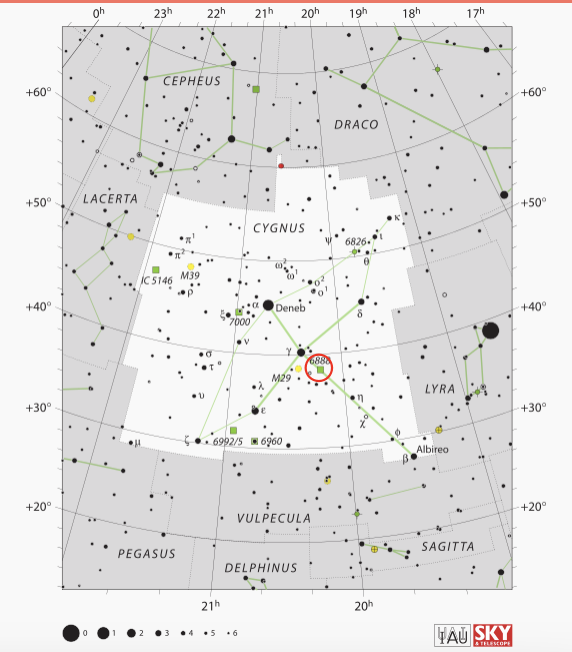
The Crescent Nebula (also known as NGC 6888, Caldwell 27, Sharpless 105) is an emission nebula in the constellation Cygnus, about 5000 light-years away from Earth. It was discovered by William Herschel in 1792.[2] It is formed by the fast stellar wind from the Wolf-Rayet star WR 136 (HD 192163) colliding with and energizing the slower moving wind ejected by the star when it became a red giant around 250,000[3] to 400,000[citation needed] years ago. The result of the collision is a shell and two shock waves, one moving outward and one moving inward. The inward moving shock wave heats the stellar wind to X-ray-emitting temperatures. It is a rather faint object located about 2 degrees SW of Sadr. For most telescopes it requires a UHC or OIII filter to see. Under favorable circumstances a telescope as small as 8 cm (with filter) can see its nebulosity. Larger telescopes (20 cm or more) reveal the crescent or a Euro sign shape which makes some to call it the "Euro sign nebula".
The Soap Bubble Nebula, or PN G75.5+1.7, is a planetary nebula in the constellation Cygnus,[4] near the Crescent Nebula (NGC 6888). It was discovered by amateur astronomer Dave Jurasevich using an Astro-Physics 160 mm refractor telescope with which he imaged the nebula on June 19, 2007 and on July 6, 2008.[5] The nebula was later independently noted and reported to the International Astronomical Union by Keith B. Quattrocchi and Mel Helm who imaged PN G75.5+1.7 on July 17, 2008.[6] The nebula measures 260″ in angular diameter with a central star that has a J band magnitude of 19.45.[2]
|
|||