Click on the image for FULL RES |
||||
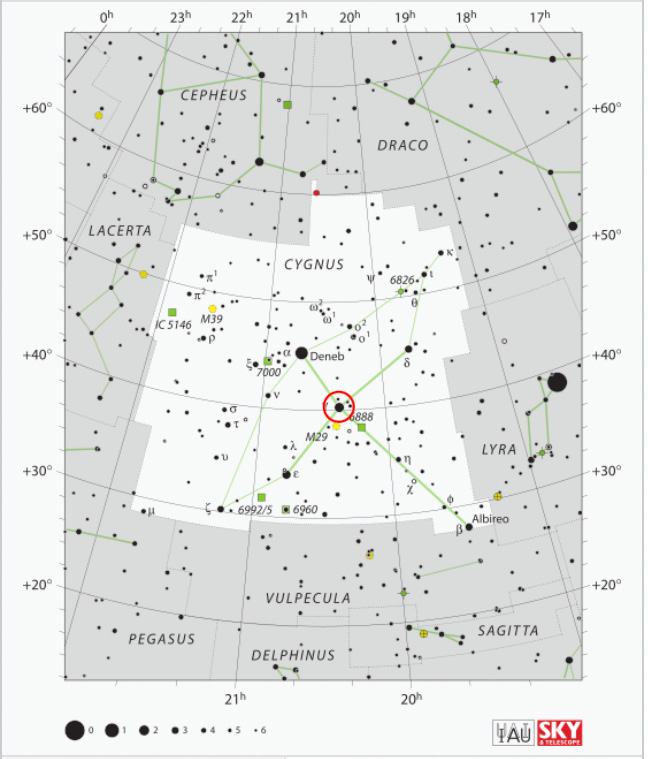
| Name / Constellation | IC 1318 |
Other: Gamma Cygni Nebula, LBN 234, Sh2-108 | Cyg |
|
| Coordinates | AR: 20h 22m - Dec: +40° 15′ | |||
| Optics | Samyang 135 f2 - Svbony 30/120 guiding refractor | |||
| Camera-Mount | ZWO ASI 533 MC Pro - ZWO ASI 174 MM Mini Guider - iOptron HAE43 EC Mount | |||
| Filters | IDAS NBZ UHC Dual Band Ha-O3 | |||
| Exposure |
|
|||
| Location / Date | Turania (Rieti) - 22 Ago 2025 | |||
| Seeing | About 2.2" @ 5.74 arcosec/pixel unbinned | |||
| Note | SHO Palette | |||
| Acquisition | NINA | |||
| Processing | Adobe Photoshop -  |
|||
| Comment |
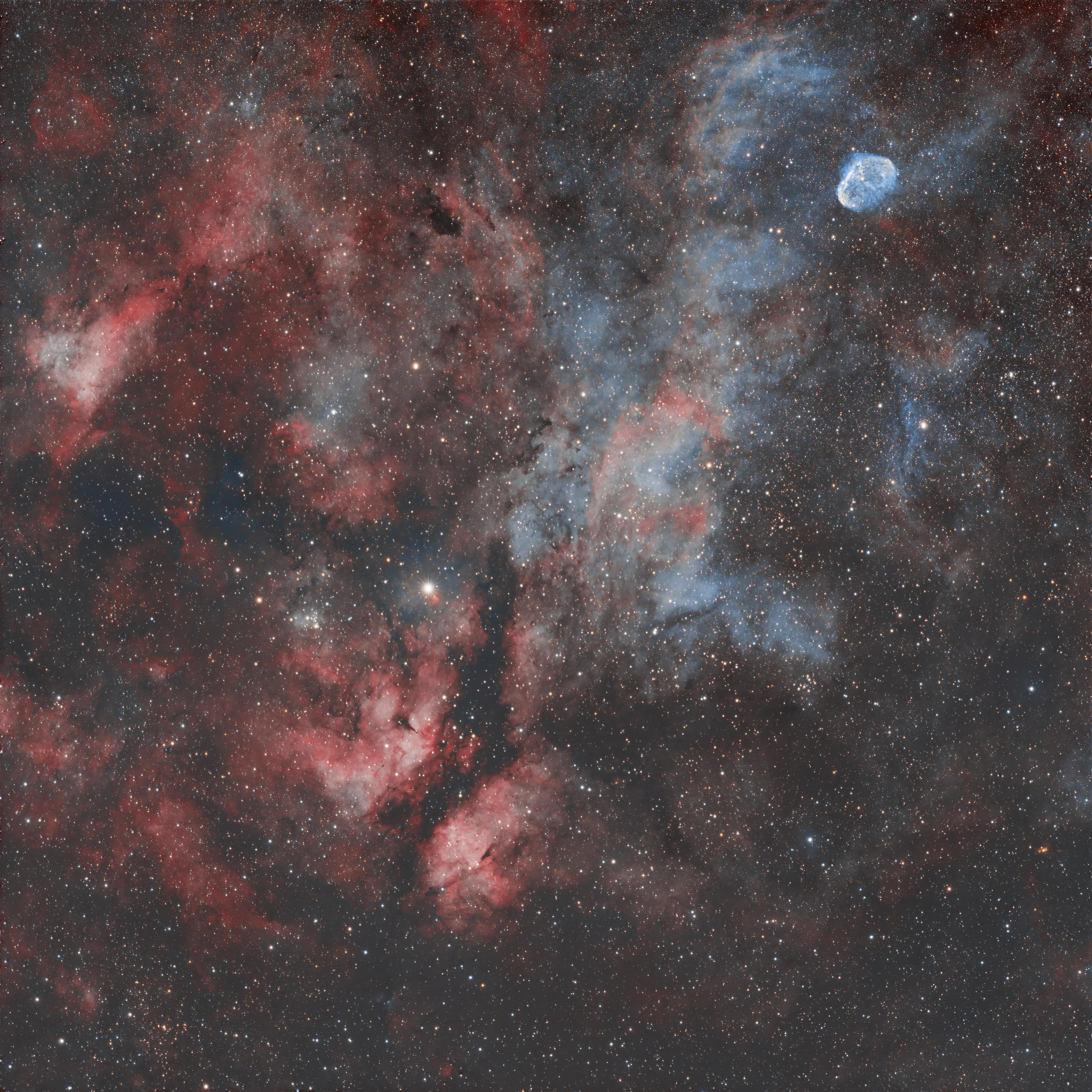
IC 1318 is a large diffuse nebula complex visible in the constellation Cygnus; it is part of the Cygnus Molecular Cloud Complex, one of the largest and most massive nebulae in our Galaxy. The most intense part directly observable is precisely the section of IC 1318 visible near the dark band LDN 889; The westernmost parts, however, appear thinner and more filamentary, suggesting that this part was actually formed by one or more supernova explosions. In the same area of sky, a large number of objects can be observed, such as the Crescent Nebula and the Butterfly Nebula, as well as some open clusters, the most famous of which is M29. IC 1318 encompasses this and other nebulae, as well as the cluster NGC 6910.
|
|||