| Name / Constellation |
IC 1848-1805 |
Other IC1848: W5; LBN 667, OCL-364, Lund 95, Sh-2199
Other IC1805: W4, Cr 26, LBN 654, Lund 81, Sh-2 190, OCL-352 |
Cas |
| Comment |
IC 1848 (also known as the Soul Nebula, the Embryo Nebula, or by its acronym W5 for Westerhout 5) is a diffuse nebula associated with an open cluster of young, hot, massive stars, visible in the constellation Cassiopeia, near the edge of Camelopardalis. This is one of the areas where star formation is most active.
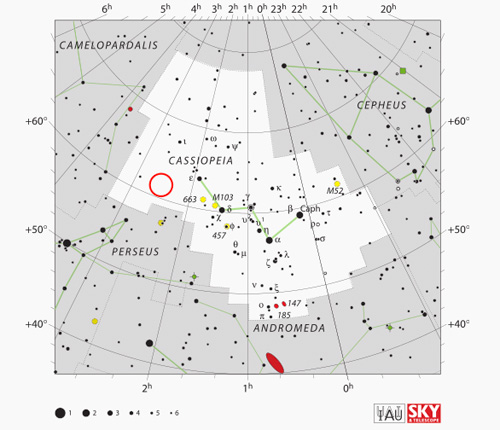
The nebula is located about 8 degrees southeast of the star ε Cassiopeiae, but can also be found by starting from the Perseus Double Cluster and moving about 5 degrees northeast. It is paired with another vast nebula, known as IC 1805. The entire complex of nebulae visible in this area appears circumpolar from most regions of the Northern Hemisphere; the best months for observation are from October to April.
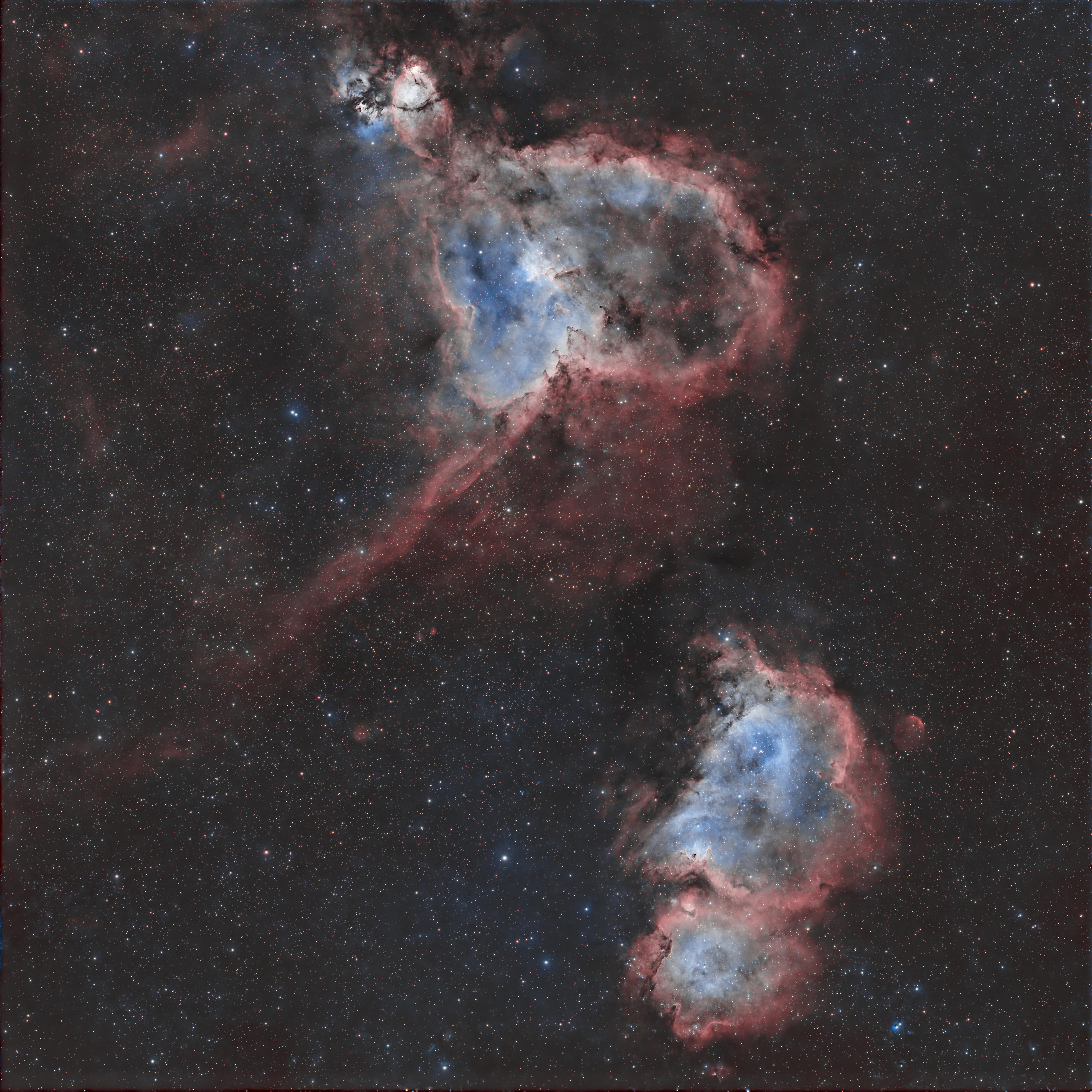
It is a very large H II region, estimated to be about 7,600 light-years away. Its gas is illuminated by the stars of several nearby clusters and associations of stars, among which Cr 33 and Cr 34 stand out. These are two very large but unconcentrated open clusters, formed by blue giant stars born from the nebula's gas. The light is then re-emitted by the nebula in the red color typical of the hydrogen-alpha emission lines. Star formation is very active within the nebula. This nebula and the nearby IC 1805 form a large nebulous complex known as the W3/W4/W5 complex, or "Heart and Soul"; the "heart" is IC 1805, while the "soul" is represented by IC 1848.
----
IC 1805 (also known as the Heart Nebula or by its acronym W4) is a diffuse nebula associated with an open cluster, visible in the constellation Cassiopeia, near the border with Camelopardalis. The Heart Nebula observed in 2021
is located about 6 degrees southeast of the star ε Cassiopeiae, but can also be found by starting from the Perseus Double Cluster and moving about 4-5 degrees north-northeast. It is paired with another vast nebula, known as IC 1848. It is a very large HII region, estimated to be about 7,500 light-years away from us. Its main characteristic is the presence of two large, apparently empty areas of different sizes, giving the nebula a "heart" shape. Within it lies a system of small, loosely concentrated open clusters, responsible for the nebula's ionization. The most notable of these is Melotte 15, which contains some stars about 50 times more massive than the Sun, plus other smaller ones and a microquasar ejected millions of years ago. W4 has a shell-like structure and is the largest of the three main nebulae in the complex; at its center lies the open cluster IC 1805, a designation sometimes also used for the entire associated nebula. IC 1805 actually forms the central part of the large Cassiopeia OB6 association; the brightest stars in the cluster are blue dwarfs, 24 of which have a mass greater than 10 M☉ and are between 1 and 3 million years old. Among these blue stars are nine of spectral class O, enclosed within a radius of about 10 pc, while the total radius of the open cluster is about 18 pc. Of these O-class stars, radial velocity and Gaussian curve studies have revealed that six are double stars; among these, one, HD 15558, appears to be a triple star. Multiple episodes of star formation are active near the nebula; images obtained in H-α have revealed an expanding superbubble of ionized hydrogen, 1200 pc in size, emerging from the galactic plane. Its age, approximately 10-20 million years, suggests it originated from the stellar wind of an early generation of massive stars. From this region, more than 30 molecular clouds and globules are emerging, dispersed in the surrounding space, as seen above. Their presence suggests that a giant molecular cloud once existed in the region, which later dissolved due to an initial intense episode of star formation.
|
 - Adobe Photoshop