| Comment |
IC 1848 (also known as Soul Nebula, Embryo Nebula or with the acronym W5 for Westerhout 5) is a diffuse nebula associated with an open cluster of young and hot stars of large mass, visible in the constellation Cassiopea, towards the border with the Giraffe. This is one of the areas where stellar formation is most active.
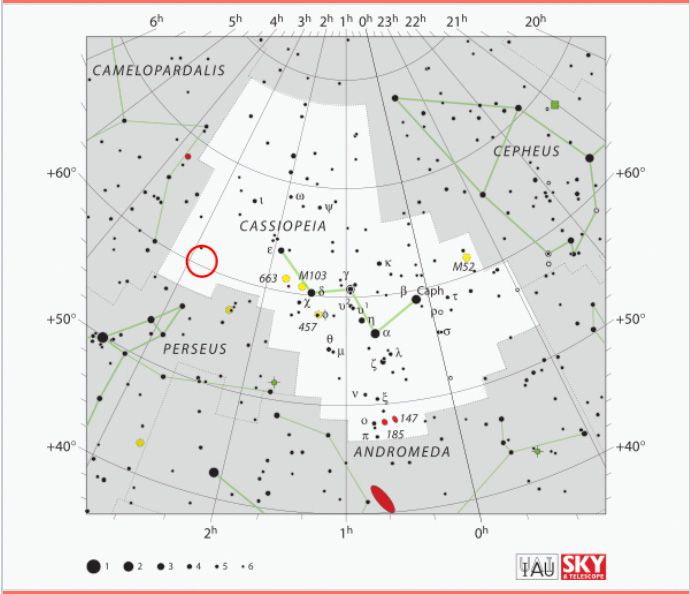
The nebula can be detected about 8 degrees southeast of the star ε Cassiopeiae, but it can also be seen starting from the Double Mass of Perseus and moving about 5 degrees in a northeast direction; it pairs with another vast nebula, known as IC 1805. To be able to locate it, you need a telescope with a large diameter, not so much for the size, since the nebula is quite extensive, but for its weakness. A long-lasting photo or a CCD camera instead reveals the object with some ease. The entire complex of nebula visible in this area is circumpolar from most regions of the northern hemisphere; the best months to observe it are from October to April.
It is a very large H II region, whose distance is estimated at 7600 light years from us; its gas is illuminated by the stars of some clusters and associations of nearby stars, among which Cr 33 and Cr 34 stand out, two very large open clusters but without concentration, formed by giant blue stars born from the gases of the nebula. The light is then re-emitted by the nebula in the red color typical of the H-alpha hydrogen emission lines. Star formation is very active inside the nebula.
This and the nearby IC 1805 form a large nebulous complex known as the W3/W4/W5 complex or "Heart and Soul"; the "heart" is IC 1808, while the "soul" is represented by this nebula.
W5 appears in visible light as a cloud physically separated from the W3-W4 complex (the Heart Nebula); it has an elongated shape in the east-west direction and contains within it the association of OB stars cataloged as IC 1848. The cloud, which structurally has a shell shape like the previous ones, can be divided into two sections, indicated as W5-E and W5-W, respectively extended by 35 and 52 pc. W5-E is the eastern section and contains a class O7V star (a very hot main sequence star), BD+59° 0578, whose stellar wind seems to be powerful enough to ionize the entire region in which it is located; W5-W, the western section, instead contains four O-class stars, but there could also be others in the eastern part of the region, not observable because they are completely hidden by the dense clouds. At least two of these stars are actually stellar systems: BD+59° 553 is a triple star, while BD+59° 552 is a four-star system. The intersection point between the two parts of the system bears the acronym IC 1871.
The distribution of young stellar objects, on the other hand, is concentrated in particular at 5 pc inside the edge of the ionized gas shell; the time scale of about 0.5–1 million years derived from the interaction between the expanding region H II and the thickenings in which the young stellar objects are found suggests that it was the expansion of the same region of ionized gas that favored the formation of new stars.
|