| Comment |
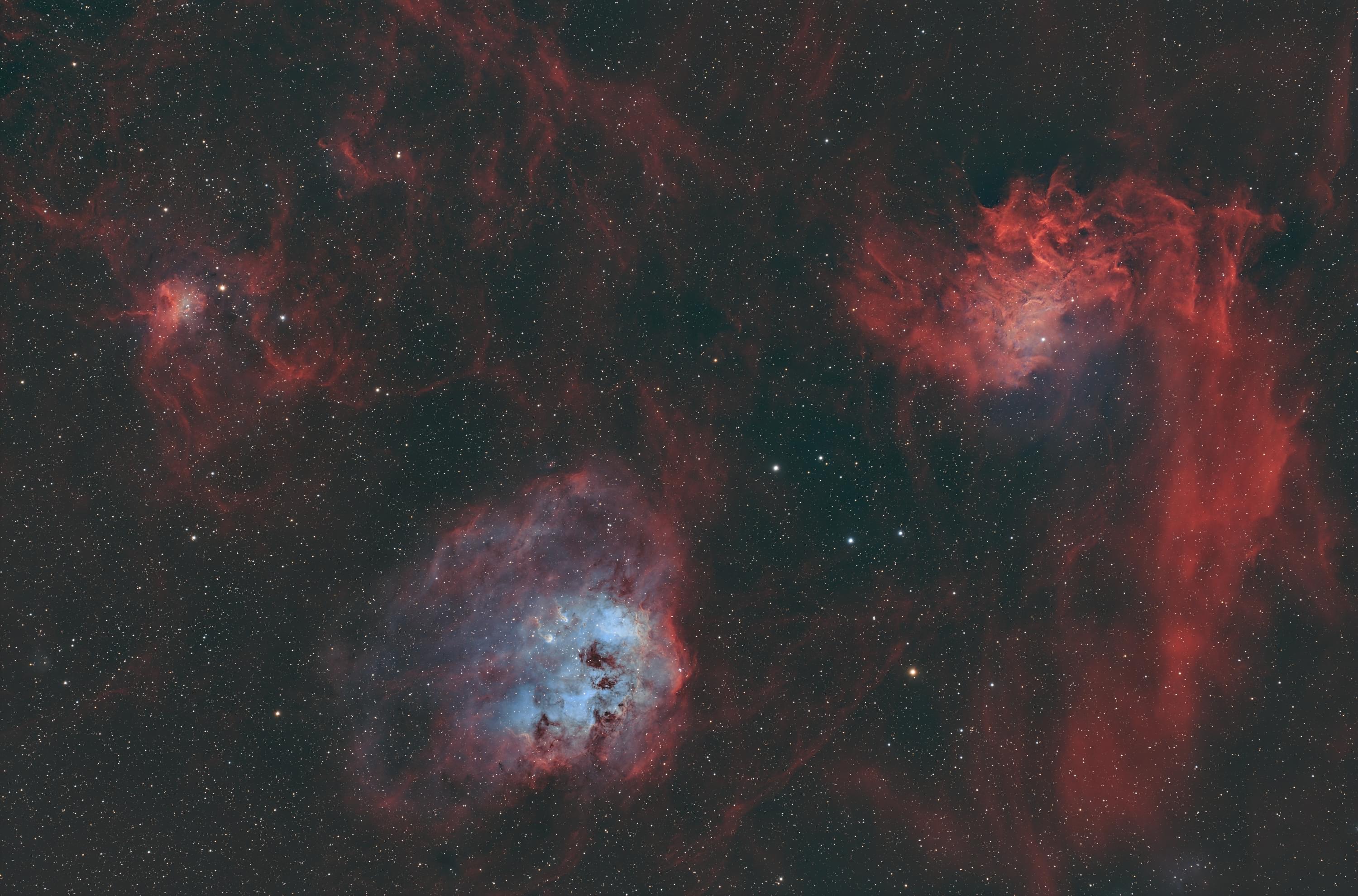
Located 1630 Mly away, IC 405 is an emission/reflection nebula sorroundin the bluish star AE Aurigae. Apparent size 37' x 10', it appears to be linked to other nebulosity zones as IC410.
IC 410 is a good example of cosmic region in which big mass stars are forming. Distant 19640 ly it's a great dimensions nebula with apparent 55' x 55' field. The NGC 1896 open cluster is located in the centre of the nebula and ots stars are responsible for H-II ionizzaztion.
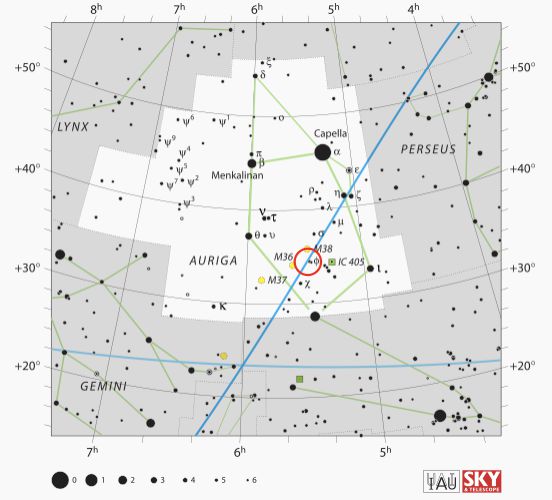
C 417, sometimes known as Spider Nebula, is a large visible emission nebula in the constellation of Auriga; it is linked to the open Stock 8 cluster and is the site of important star formation processes. IC 417 is located in the central-southern part of the constellation, in a region very rich in star fields and nebulae halfway between the stars ι Aurigae and θ Aurigae; in its immediate vicinity the star φ Aurigae is observed, which with its magnitude 5.08 represents a valid reference. Through an optical instrument it is possible to distinguish the central open cluster, which is formed by a few dozen stars up to magnitude 12 arranged in alignments and concatenations and dominated towards the south by two stars of magnitude 9. The nebulous contour instead remains invisible to the telescopes of diameter more widespread and can be revealed by long exposure photographs. The most suitable period for its observation in the evening sky falls between the months of October and March and is greatly facilitated for observers located in the regions of the terrestrial northern hemisphere; in the northernmost latitudes it occurs circumpolar, while from areas such as the southern tip of South America it can practically never be observed.
|