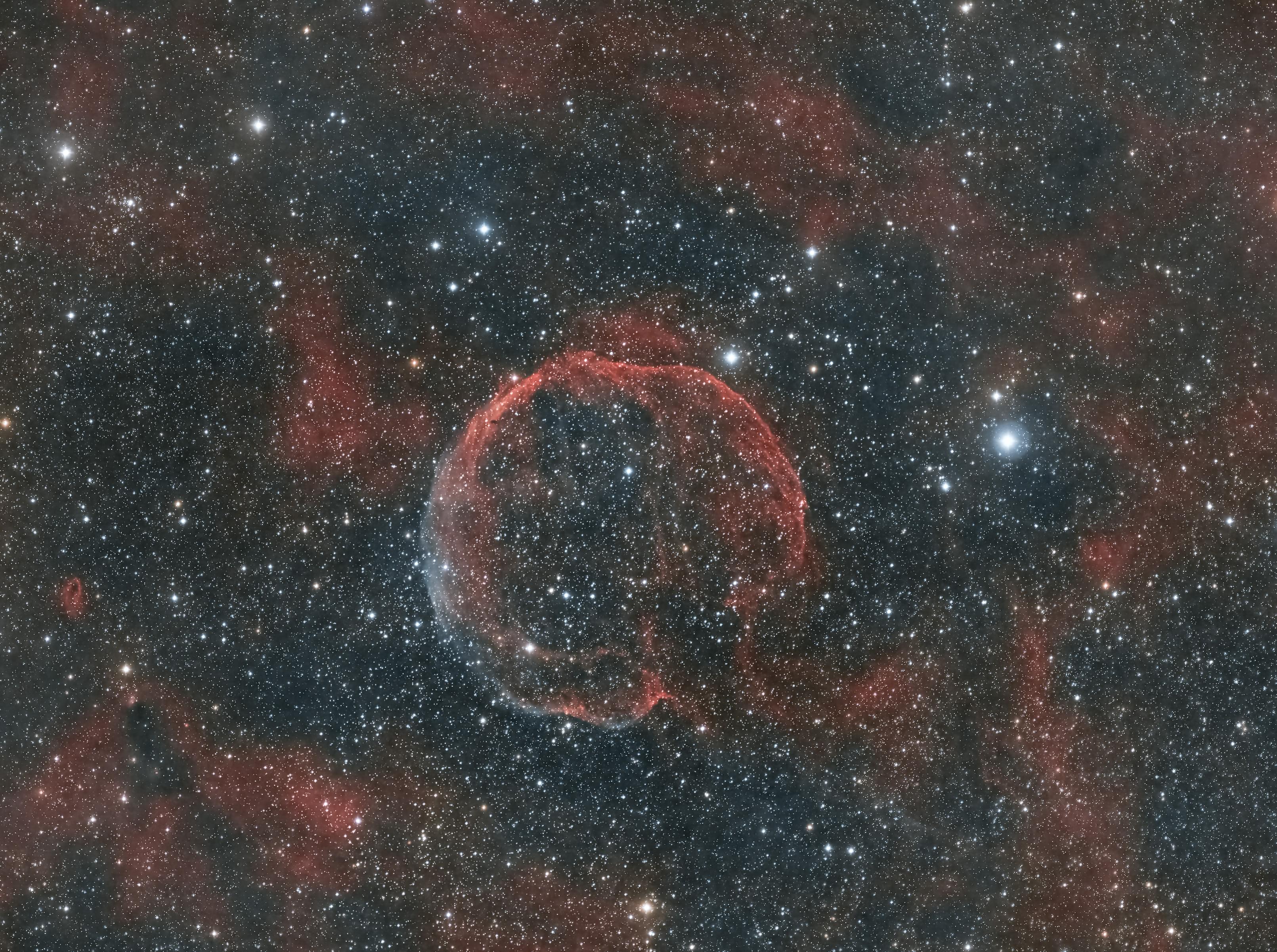
|
| Name / Constellation |
LBN 576 |
Other: Abell 85, CTB1, Garlic Head Nebula |
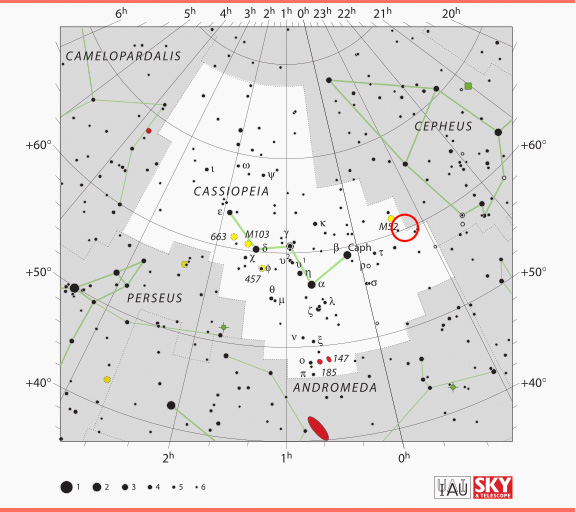
Cas |
| Coordinates |
AR: 23h 59’ 31.7” - Dec: +62° 29′ 13 |
| Optics |
Takahashi FSQ 106N APO Fluorite F5 - 60/220 guiding refractor |
| Camera-Mount |
SBIG STF8300M - Orion StarShot Guider - 10Micron GM2000 QCI Mount |
| Filters |
Baader Ha - Oxy3 |
| Exposure |
- H alpha
- Oxy 3
- Red
- Green
- Blue
|
- 51 x 900 sec - 12 hours 45min
- 32 x 900 sec - 8 hours
- 9 x 180 sec - 27 min
- 9 x 180 sec - 27 min
- 9 x 180 sec - 27 min
|
- UNBINNED
- UNBINNED
- UNBINNED
- UNBINNED
- UNBINNED
|
| Location / Date |
Promiod (Valle D'Aosta-Italy) "TLP" Remote Observatory - Sept 2023 |
| Seeing |
About 2.8" @ 2.1 arcosec/pixel unbinned |
| Note |
|
| Acquisition |
N.I.N.A. |
| Processing |
Adobe Photoshop -  |
| Comment |
LBN 576 is the expanding gas shell that was left when a massive star toward the constellation of Cassiopeia exploded about 10,000 years ago. The star likely detonated when it ran out of elements, near its core, that could create stabilizing pressure with nuclear fusion. The resulting supernova remnant, nicknamed the Popped Balloon / Medulla Nebula for its brain-like shape, still glows in visible light by the heat generated by its collision with confining interstellar gas. Why the nebula also glows in X-ray light, though, remains a mystery. One hypothesis holds that an energetic pulsar was co-created that powers the nebula with a fast outwardly moving wind. Following this lead, a pulsar has recently been found in radio waves that appears to have been expelled by the supernova explosion at over 1000 kilometers per second.
|