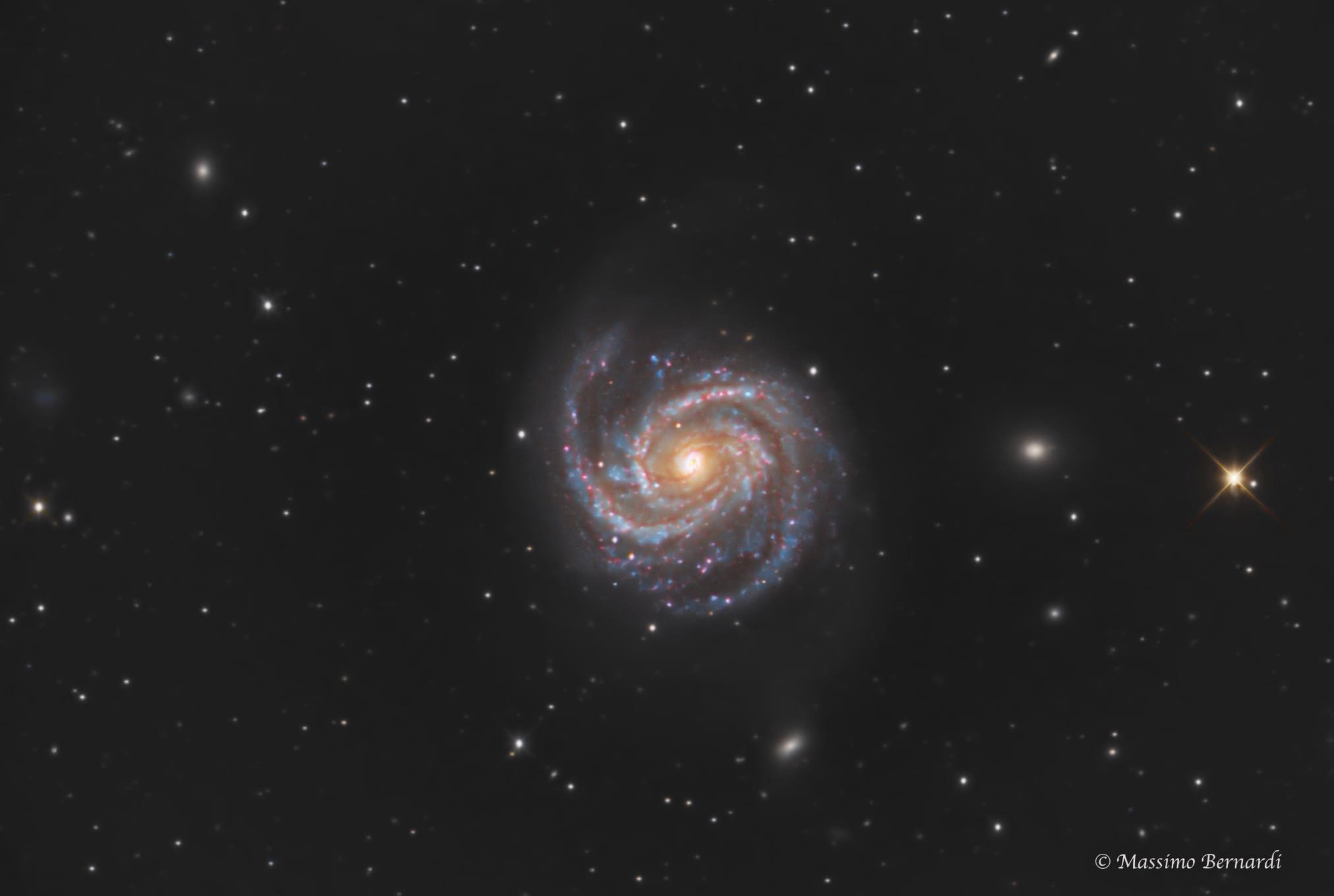
Click on the image for FULL RES |
||||
| Name / Constellation | M 100 |
Other: NGC 4321, UGC 7450, PGC 40153, CGCG 99-30 | Com |
|
| Coordinates | AR: 12h 22m 54.9s - Dec: +15° 49′ 21″ | |||
| Optics | Richtey-Chretien Officina Stellare 10"@F8 Carbon Truss | |||
| Camera-Mount | SBIG ST10XME/CFW10/ONAG/ST8300 guider - 10Micron GM2000 QCI Mount | |||
| Filters | Astrodon LRGB TruBalance (Gen 2) | |||
| Exposure |
|
|
|
|
| Location / Date | Promiod (Valle D'Aosta-Italy) "TLP" Remote Observatory - 14 feb 2019 | |||
| Seeing | About 2.8 " @ 0.71 arcosec/pixel image scale unbinned | |||
| Note | Not good seeing | |||
| Acquisition | MaxIm DL - CCD Autopilot 5 | |||
| Processing | Adobe Photoshop CS5 -  |
|||
| Comment | Messier 100 (also known as NGC 4321) is an example of a grand design[4] intermediate spiral galaxy located within the southern part of constellation Coma Berenices. It is one of the brightest and largest galaxies in the Virgo Cluster, located approximately 55 million light-years distant from Earth and has a diameter of 107,000 light years, roughly 60% the size of the Milky Way. It was discovered by Pierre Méchain on March 15, 1781 and was subsequently entered in Messier's catalogue of nebulae and star clusters after Charles Messier made observations of his own on April 13, 1781. The galaxy was one of the first spiral galaxies to be discovered, and was listed as one of fourteen spiral nebulae by Lord William Parsons of Rosse in 1850. Two satellite galaxies named NGC 4323--connected with M100 by a bridge of luminous matter--and NGC 4328 surround M100.
|
|||
