Click on the image for FULL RES |
||||
| Name / Constellation | M 106 |
Other: NGC 4258, UGC 7353, PGC 39600 | CVe |
|
| Coordinates | AR: 12h 18m 57,5s - Dec: +47° 18′ 14″ | |||
| Optics | Officina Stellare 10" f8 Richtey-Cretien | |||
| Camera-Mount | SBIG ST10XME/CFW10 - ZWO ASI1600MM guider (ONAG) - 10Micron GM2000 QCI Mount | |||
| Filters | Astrodon Gen. II - LRGB | |||
| Exposure |
|
|
|
|
| Location / Date | Promiod (Valle D'Aosta-Italy) "TLP" Remote Observatory - Mar 2023 | |||
| Seeing | 2.9" @ 0.7 arcosec/pixel unbinned | |||
| Note | ||||
| Acquisition | N.I.N.A | |||
| Processing | Adobe Photoshop -  |
|||
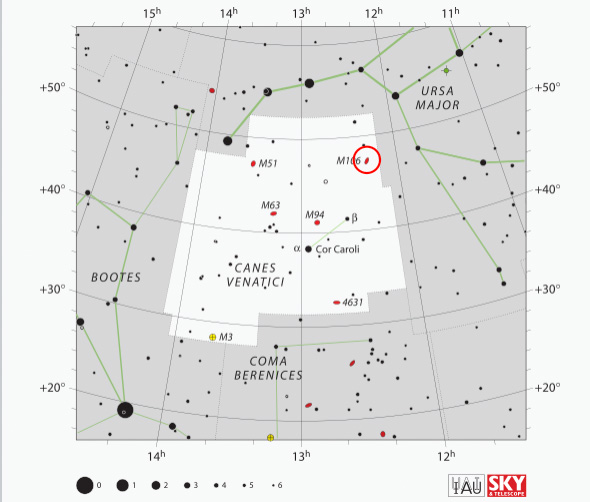
| Comment | M 106 (also known as NGC 4258) is a spiral galaxy visible in the constellation of Canes Venatici; it seems that its interior hosts a supermassive black hole. M106 is located about 2° south of the star 3 Canum Venaticorum, a fifth magnitude star located a few degrees south-east of Phecda, this last part of the asterism of the Big Dipper; thanks to its brightness it is easily identifiable even with 10x50 binoculars, provided that the night is favorable, in which it appears as an ovoid-shaped spot. A small amateur telescope is able to show the brighter nucleus, while instruments with 150-200mm aperture are the minimum required to identify some details such as the irregularity of the brightness of the halo and the spiral arms. Its declination is very northern: in fact this galaxy appears circumpolar from a large part of the northern hemisphere, such as a large part of Europe and part of North America; from the southern hemisphere instead it is possible to observe it up to the medium temperate latitudes. The best period for its observation in the northern sky is between January and August. M106 was discovered by Pierre Méchain in July 1781; he described it as a nebulous object located between Ursa Major and Canis Venatici. Charles Messier observed this object and indicated its position, but did not include it in his famous catalogue because it had already been published; only in the fifties of the twentieth century was this catalogue extended. Admiral Smyth described it as a rather large and oval white nebula, oriented from NW to SE and with a brighter nucleus in the southern region and sharper lateral edges at its extremities; finally, Father Heinrich Ludwig d'Arrest observed it with a 280mm aperture telescope, describing it as a complex object with a bright nucleus and arms extended to the north and south. M106 is an example of a Seyfert galaxy; the detection of unusual radio and X-ray emissions observed by the Very Large Baseline Array radio telescope indicates that part of the galaxy is probably falling into a supermassive black hole located in its center: in fact, the nucleus seems to contain a mass equal to 36 million solar masses, concentrated in a volume between 1/24 and 1/12 of a light year, or between 12,000 and 54,000 AU. The shape of M106 resembles that of the Andromeda Galaxy (M31), but with a different inclination, so that all the structures of the dust clouds on the galactic plane are perfectly visible; the spiral arms are rich in H II regions that appear blue and red in the images, depending on whether or not they are associated with clusters of particularly hot and bright stars. In 1981, a supernova appeared in its arms, classified as SN 1981K, which reached the sixteenth apparent magnitude; since the spectrum was not analyzed, it was never known what type of supernova it was. The distance of the galaxy is estimated at 21-25 million light years and its total mass is equal to about 190 billion solar masses; it is moving away from us at a speed of 537 km/s.
|
|||