Click on the image for FULL RES |
||||
| Name / Constellation | M 10 |
Other: NGC 6254 | Oph |
|
| Coordinates | AR: 16h 57m 08.99s, -04° 05′ 57.6″ | |||
| Optics | Officina Stellare 10" f8 Richtey-Cretien | |||
| Camera-Mount | PLAYERONE POSEIDON M-PRO - ZWO ASI 1600M (ONAG)- 10Micron GM2000 QCI Mount | |||
| Filters | Antlia V-Pro LRGB | |||
| Exposure |
|
|
|
|
| Location / Date | Promiod (Valle D'Aosta-Italy) "TLP" Remote Observatory - Jul 2024 | |||
| Seeing | 2.6" @ 1.17 arcosec/pixel binning 3 | |||
| Note | Drizzle 2X in postprocessing (Pixinsight)) | |||
| Acquisition | N.I.N.A. | |||
| Processing | Adobe Photoshop CC -  |
|||
| Comment |
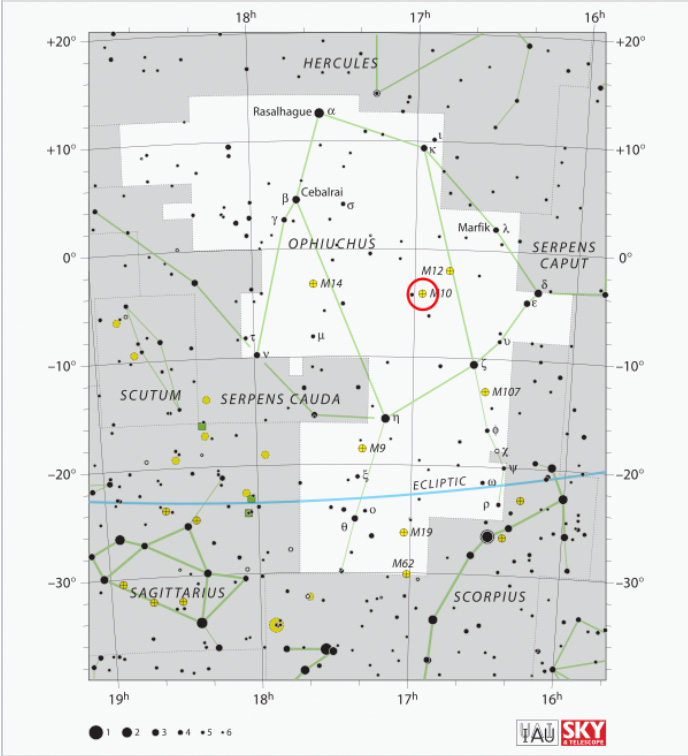
M 10 (also known as NGC 6254) is a globular cluster located in the constellation of Ophiuchus. M10 is not easily identified because of its particularly isolated position, far from bright stars; its position is located about 10° east of the star ε Ophiuchi. Thanks to its magnitude of 6.6, the cluster is easily visible with binoculars. M10 was discovered by Charles Messier in 1764, who however did not recognize it as a cluster and described it as follows: "A starless nebula in the belt of Ophiuchus, near the 30th star of this constellation...This nebula is beautiful and round, can only be seen with difficulty in an ordinary three-foot telescope." It was resolved into stars for the first time by William Herschel.
|
|||