Click on the image for FULL RES |
||||
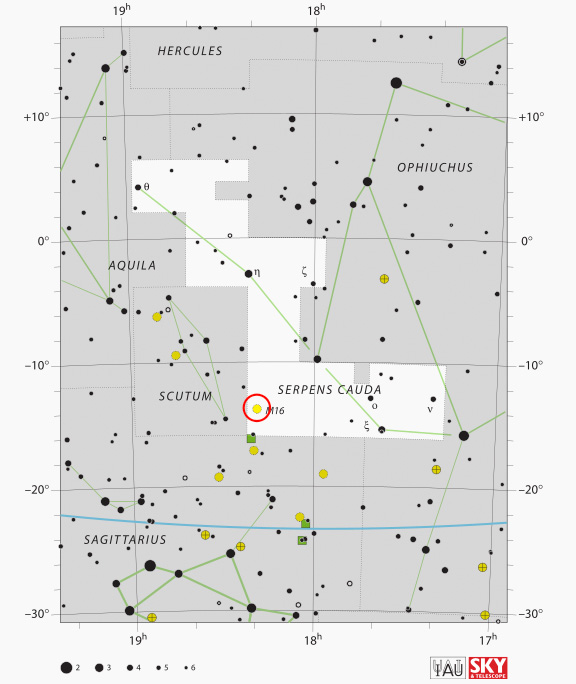
| Name / Constellation | M 16 |
Other: Other: NGC 6611, Sharpless 49, RCW 165, Gum 83, Star Queen Nebula, Eagle Nebula | Ser |
|
| Coordinates | AR: 18h 18m 48s - Dec: −13° 49′ | |||
| Optics | Takahashi FSQ 106N APO Fluorite F5 - 60/220 guiding refractor | |||
| Camera-Mount | ZWO ASI 294 MC Pro - Orion StarShot Guider - 10Micron GM2000 QCI Mount | |||
| Filters | Askar Magic D1 Dual Band Ha-O3 | |||
| Exposure |
|
|||
| Location / Date | Promiod (Valle D'Aosta-Italy) "TLP" Remote Observatory - 25 jun 2025 | |||
| Seeing | About 2.2" @ 1.8 arcosec/pixel unbinned | |||
| Note | SHO Palette | |||
| Acquisition | NINA | |||
| Processing | Adobe Photoshop -  |
|||
| Comment |
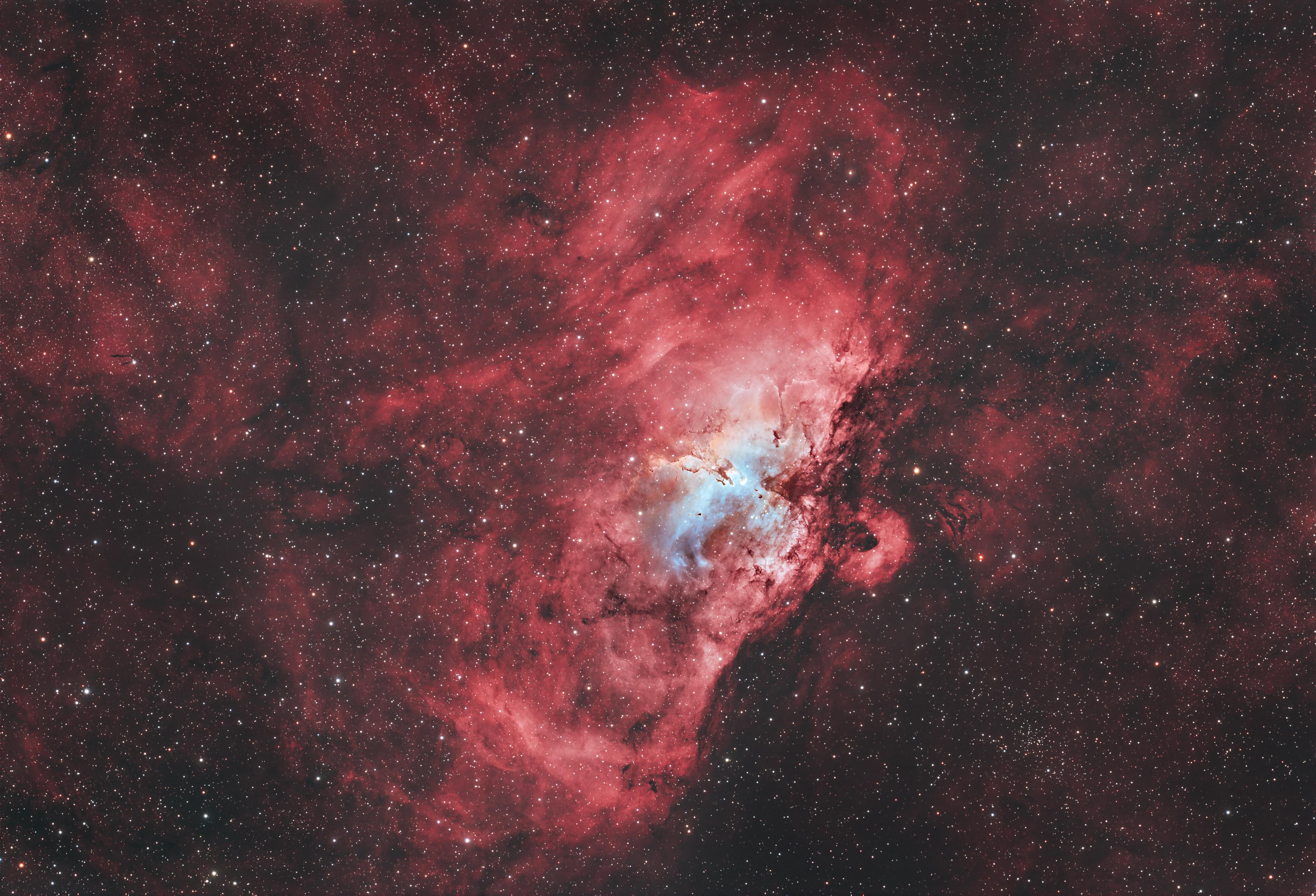
The Eagle Nebula (catalogued as Messier 16 or M16, and as NGC 6611, and also known as the Star Queen Nebula and The Spire) is a young open cluster of stars in the constellation Serpens, discovered by Jean-Philippe de Chéseaux in 1745–46. Both the "Eagle" and the "Star Queen" refer to visual impressions of the dark silhouette near the center of the nebula,[2][3] an area made famous as the "Pillars of Creation" imaged by the Hubble Space Telescope. The nebula contains several active star-forming gas and dust regions, including the Pillars of Creation.
|
|||