Click on the image for FULL RES |
||||
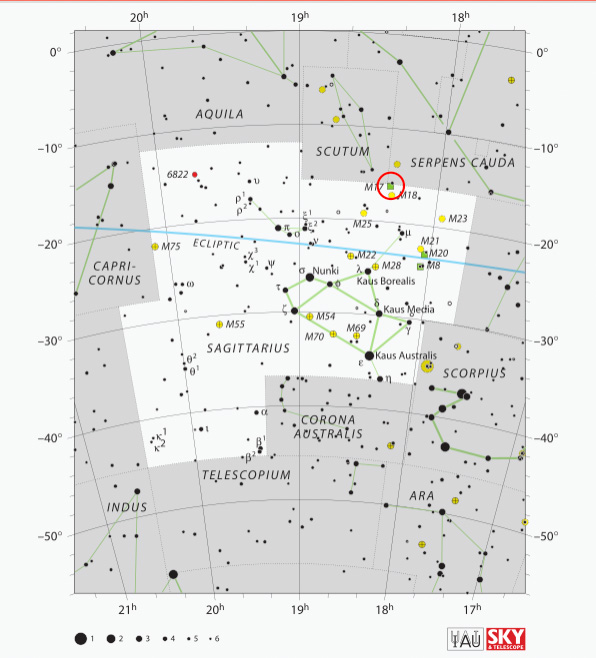
| Name / Constellation | M 17 |
Other: NGC 6618, Sh-2 45, RCW 160, Gum 81 | Sag |
|
| Coordinates | AR: 18h 20m 26s - Dec: -16° 10′ 36″ | |||
| Optics | Takahashi FSQ 106N APO Fluorite F5 - 60/220 guiding refractor | |||
| Camera-Mount | SBIG STF8300M - Orion StarShot Guider - 10Micron GM2000 QCI Mount | |||
| Filters | Baader Ha-Oxy3_Sul2 | |||
| Exposure |
|
|
|
|
| Location / Date | Promiod (Valle D'Aosta-Italy) "TLP" Remote Observatory - Jul 2023 | |||
| Seeing | 2.5-3" @ 2.1 arcosec/pixel unbinned | |||
| Note | SHO palette | |||
| Acquisition | N.I.N.A. | |||
| Processing | Adobe Photoshop -  |
|||
| Comment |
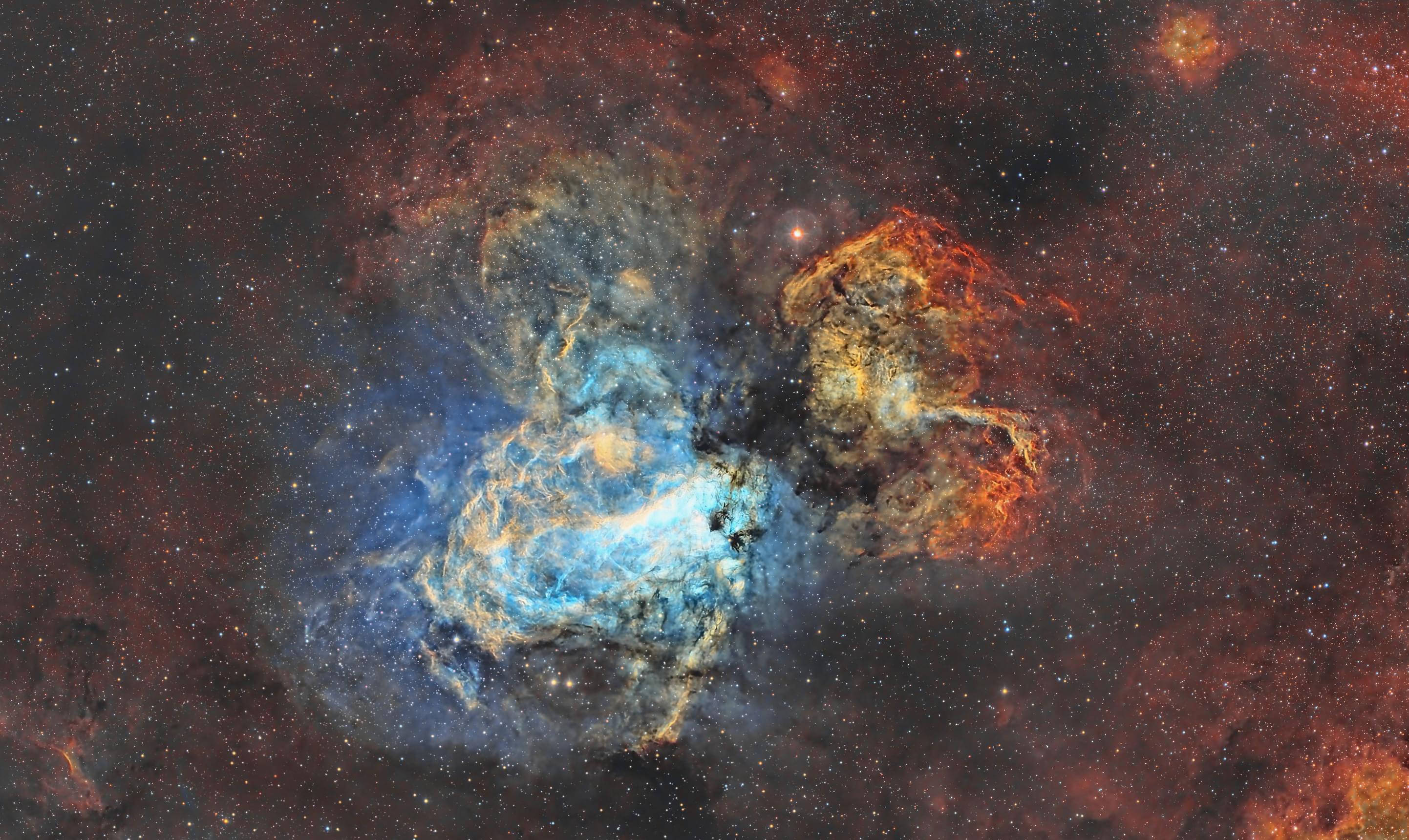
The Omega Nebula (also known as the Swan Nebula, Horseshoe Nebula, Lobster Nebula or with the catalog acronyms M 17 and NGC 6618) is an emission nebula, discovered by de Chéseaux in 1746 and rediscovered by Charles Messier in 1764, located in the constellation of Sagittarius. Thanks to its brightness, the Omega Nebula is quite easy to locate: it is in fact located 2° south-east of the star γ Scuti. It can be identified with reasonable ease even with 10x50 binoculars or even smaller, if the sky is dark and clear: it appears in these instruments as an elongated spot; through a 114 mm instrument, equipped with a UHC filter, it reveals a good part of its nuances and its plays of light. Starting from 200 mm the vision is exceptional, and it is advisable to take a long exposure photo to capture the pink color. The Omega Nebula can be observed with reasonable ease from most populated areas of the Earth, thanks to the fact that it is located at a declination that is not excessively southern: in some areas of Northern Europe and Canada, near the Arctic Circle, its visibility is still very difficult, while in central Europe it appears relatively low; from the southern hemisphere the nebula is clearly visible high on the nights of the southern winter and in its tropical belt it can be seen perfectly at the zenith. The best period for its observation in the evening sky is between June and October. The nebula was discovered by Philippe Loys de Chéseaux in 1746, although the discovery was never published; Charles Messier thus made an independent rediscovery of it, indicating it as a very elongated nebula similar to that of the "Andromeda Nebula" (the galaxy M31). William Herschel and his son John described it as a bright trail with a separate knot, also indicating that part of the cloud is probably obscured; Admiral Smyth defines its proper name, which has remained to this day, as the Horseshoe Nebula or Omega Nebula, due to its apparently curved shape on the north side. The Omega Nebula, being at a distance of about 6000 light years from us, is located on a galactic spiral arm more internal to our Orion Arm, the Sagittarius Arm, on which lie also other very bright objects such as many of the open clusters visible between the constellations of Scorpius and Centaurus, up to the Carina Nebula. A 2008 study states however that this arm would be only a large condensation of gas and dust from which several young stars were born. The line of sight from Earth to the nebula is disturbed by the presence of interstellar dust, also due to the long distance, but it still appears less obscured than other adjacent areas: in fact, the nebula is visible on the edge of the so-called Eagle Rift, a long trail of dark nebulae belonging to our spiral arm that completely shield the light coming from the stars in the northern band of the Sagittarius Arm. To these clouds should also be added the Sh2-54 complex, to which the open cluster NGC 6604 is connected, whose relationship with the Eagle Nebula was already known years before. According to scientists, it is also possible to define an evolution on a time scale of the molecular cloud: the first region where star formation took place is the northern one, coinciding with Sh2-54, which gave rise to some bright OB associations about 4 million years ago; later, formation phenomena affected the region of the Eagle Nebula, 2-3 million years ago, and only recently (1 million years ago) the Omega Nebula. The causes of the extension of the formation phenomena could have been different: it could have been caused by a large domino effect in which the new stars with their stellar wind compressed the gases of the adjacent regions causing them to collapse on themselves, or the compression could have been caused by the explosion of several supernovae originating from the most massive stars resulting from the formation. Another possibility could be that the compression of the gases occurred as the nebulous complex entered the denser regions of the spiral arm on which it is located. The giant molecular cloud has a superbubble shape and many of its associated young stars are found inside it; however, the superbubble seems to have an age of several million years greater than that of the cloud itself, indicating that it is a structure that already existed before the influx of the cloud. The interaction with this superbubble (and not its expansion effects) could have been at the origin of the first star formation phenomena in the region. According to some authors, this region could be even more extensive, even incorporating the Nebula
|
|||