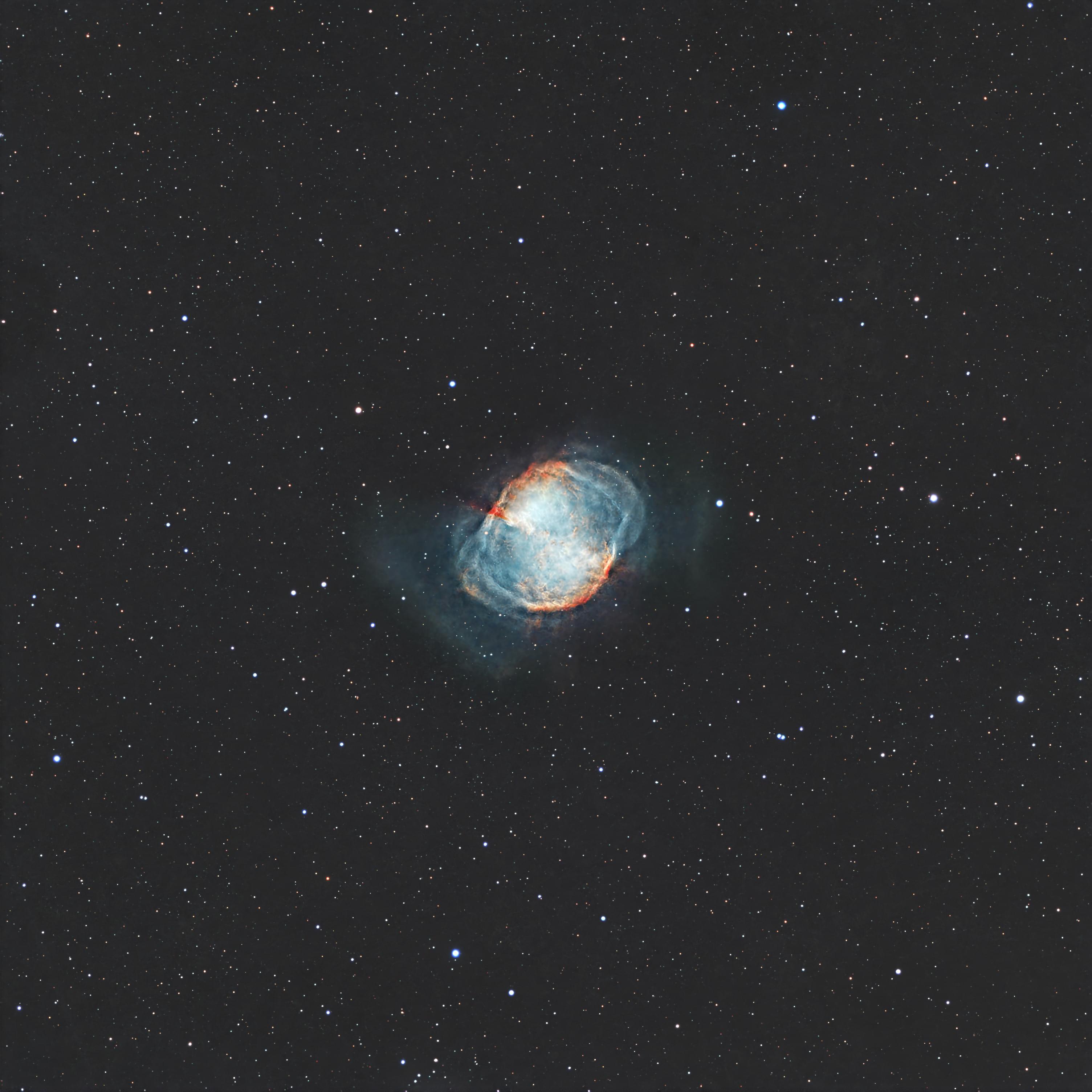
Click on the image for FULL RES |
||||
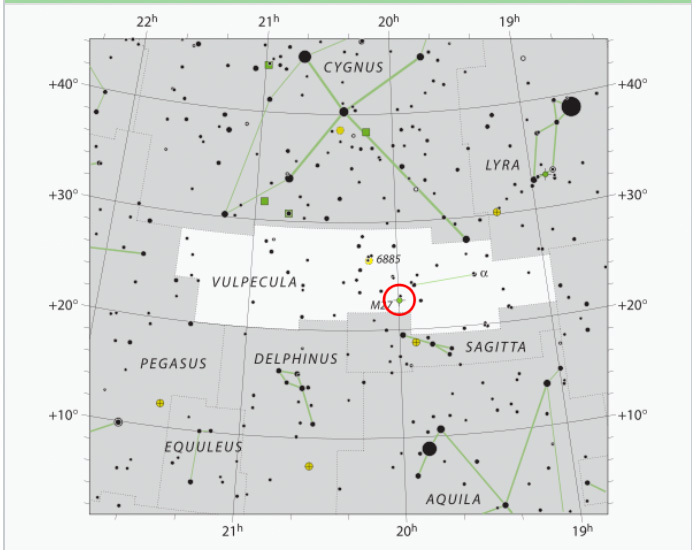
| Name / Constellation | M 27 |
Other: NGC 6853 - Dunbell Nebula | Vul |
|
| Coordinates | AR: 19h 59m 36.34s - Dec: +22° 43′ 16.09″ | |||
| Optics | Astrophysics 130 EDFS f6 - Svbony 30/160mm guide scope + ZWO ASI 174 MM Mini | |||
| Camera-Mount | ZWO ASI 533 MC Pro - iOptron CEM40 Mount | |||
| Filters | Antlia Triband RGB Ultra | |||
|
||||
| Location / Date | Novara City (Italy) - May 2025 | |||
| Seeing | Bortle 7.6 | |||
| Note | ||||
| Acquisition | N.I.N.A. | |||
| Processing | Adobe Photoshop -  |
|||
| Comment |
The Dumbbell Nebula (also known as the Dumbbell Nebula, or by its catalog designations M 27 and NGC 6853) is a famous and bright planetary nebula visible in the constellation Vulpecula. The Dumbbell Nebula is quite easy to locate, lying about three degrees north of the magnitude 3.5 star γ Sagittae; it is easily visible even with 10x50 binoculars and, on very dark and clear nights, even with smaller instruments, such as 8x30. A 114mm telescope can already reveal its main feature, a shape vaguely reminiscent of an hourglass due to the cloud's two large, bright lobes; more powerful instruments, preferably equipped with appropriate filters, allow for a greater degree of detail and nuance. The small central star, at magnitude 13.6, is often used as a test to determine the clarity of a starry night using 200mm telescopes. The Dumbbell Nebula can be easily observed from both hemispheres of the Earth, thanks to its not excessively northerly declination. From the northern regions, however, it is more visible and appears extremely high in the sky on summer nights, while from the southern hemisphere it remains consistently low, except for areas near the equator. It is, however, visible from all inhabited areas of the Earth. The best time to observe it in the evening sky is between June and November. As in many other nearby planetary nebulae, knots are easily visible in M27; Its central region is marked by a layer of dark and bright knots, associated with filaments. The knots exhibit a wide range of morphologies, from symmetrical with filamentary tails to asymmetrical with no tails at all. Similar to what was observed in the Helix Nebula and the Eskimo Nebula, the heads of the knots have bright cusps, corresponding to areas of local photoionization fronts.The central star is a white dwarf with a radius of 0.055 ± 0.02 R☉, larger than any other known white dwarf; the mass of the central star was estimated in 1999 at 0.56 ± 0.01 M☉
|
|||