| Comment |
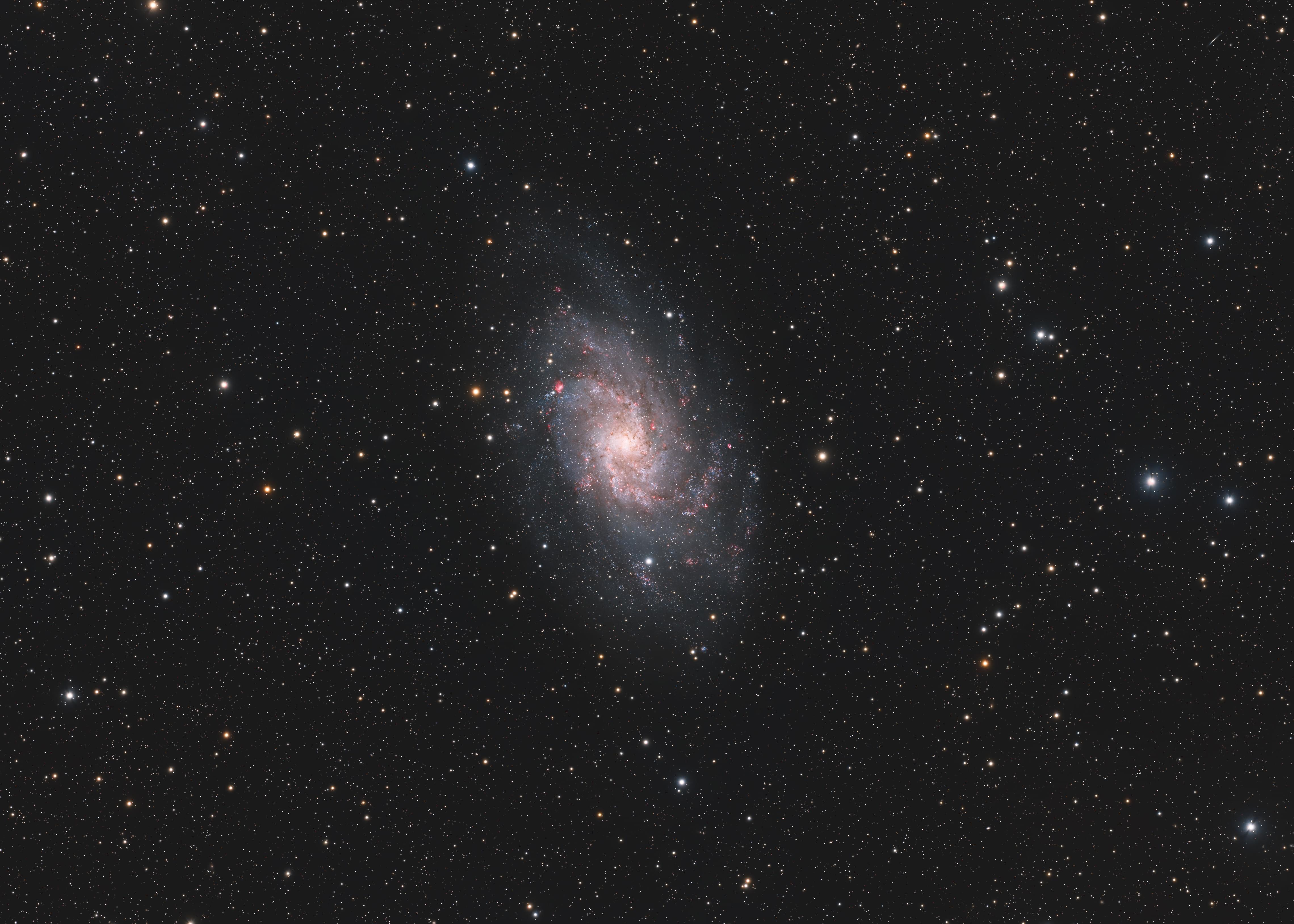
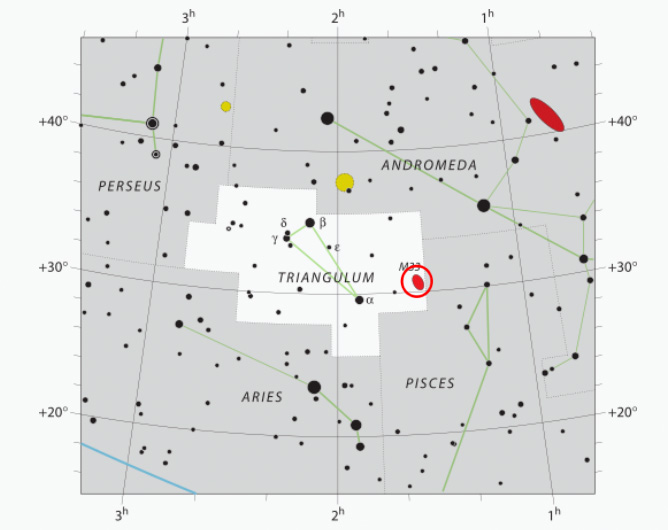
The Triangulum Galaxy, also known as M33 (object number 33 in the Charles Messier catalog) and NGC 598, is a SA(s)cd spiral galaxy located about 3 million light-years from Earth in the constellation of Triangulum. In the English-speaking world, M33 is also informally called the Pinwheel Galaxy in some amateur astronomy publications, as well as in official press releases on professional websites. However, both the SIMBAD astronomical database, which contains the names and formal designations of various astronomical objects, and several other amateur astronomy websites refer to the galaxy M101 as the "Pinwheel Galaxy."
The Triangulum Galaxy is the second closest non-dwarf galaxy to the Milky Way after the Andromeda Galaxy (M31). It can be seen with binoculars under dark skies, where it appears as an oval-shaped patch with irregular edges; under exceptionally clear skies, where light pollution is sufficiently low, it is even possible to notice it with the naked eye, through averted vision. Indeed, being a diffuse object, its visibility is strongly affected by even a small amount of light pollution and can vary from easily visible in direct vision in very dark skies to very difficult to discern with averted vision in skies over rural and suburban areas. While most people consider the Triangulum Galaxy to be the most distant visible object, expert observers claim to have observed M81 and Centaurus A with the naked eye, two galaxies that are more distant and have an apparent brightness lower than M33.
This Galaxy was likely discovered before 1654 by Giovanni Battista Hodierna, who may have grouped it together with the open cluster NGC 752; It was later independently rediscovered by Charles Messier, who catalogued it as M33 on August 25, 1764. M33 was finally observed and independently recatalogued by William Herschel on September 11, 1784, assigning it the number H V.17. It was identified as a "spiral nebula" by William Parsons and was one of the first galaxies ever to reveal a spiral structure, although the true nature of spiral "nebulae" was not yet known at the time.
Herschel also catalogued the brightest H II region (an emission nebula containing ionized hydrogen) in the Triangulum Galaxy as H III.150, separately from the galaxy. The H II region, which later received the designation NGC 604, is located in the northeast corner of M33 and is one of the largest known H II regions, with a diameter of nearly 1,500 ly and an electromagnetic spectrum similar to that of the Orion Nebula. Herschel also noted three other smaller H II regions actually belonging to the Triangulum Galaxy, which were named NGC 588, NGC 592, and NGC 595.
M33 was the target study object to test a new observation technology, developed specifically for the Webb Space Telescope, based on thousands of individually operated micro-shutters to sample individual celestial objects. The experimental telescope, launched on October 28, 2019, studied the dynamics of gas ejected by supernovae located in the Triangulum Galaxy.
The Triangulum Galaxy is a rather small galaxy compared to its neighbors—the Milky Way and the Andromeda Galaxy—but is actually average-sized compared to other spiral galaxies in the Universe. Specifically, it is the third-largest member of the Local Group, after the Andromeda Galaxy and the Milky Way, and could be a companion to the Andromeda Galaxy, to which it is gravitationally bound. It has two possible low-luminosity satellites: Andromeda XXII and Pisces VII. The Pisces I Dwarf Galaxy (or LGS 3), sometimes referred to as a satellite of M33, has never been confirmed in this role.
From the point of view of its conformation, M33 is an example of a flaky spiral. Spiral galaxies can have homogeneous and well-defined arms, or arms in which dust and gas are not uniformly distributed but aggregated in local collapses. The more or less homogeneous distribution of galactic material is thought to depend on the strength of a density wave that transports the material and, in effect, gives rise to the arms themselves. If the density wave is strong, the material arranges itself in clear, homogeneous arms; if the wave is weak or absent, the material aggregates into clumps. This latter situation gives rise to the typical "flake" appearance.
The Triangulum Galaxy has a nucleus with spectral characteristics similar to those of an H II region and therefore does not exhibit the violent phenomena typical of active galactic nuclei or Seyfert galaxies.
In 2005, using observations of two water masers on opposite sides of the galaxy obtained with the VLBA, astronomers were able to estimate for the first time the angular rotation and proper motion of the Triangulum Galaxy. The calculated velocity is approximately 190 ± 60 km/s, relative to the Milky Way, meaning that M33 is moving toward the Andromeda Galaxy.
In 2007, the Chandra X-ray Observatory found evidence of a 15.7 M⊙ black hole belonging to the Triangulum Galaxy; the object, called M33 X-7, orbits a companion star that eclipses it every 3.5 days.
So far, no supernovae have been observed in the galaxy; six novae have been observed.
The first attempts to measure the distance to the Triangulum Galaxy date back to the late 1980s, using the Tully-Fisher relation, which links a galaxy's intrinsic luminosity to the amplitude of its rotation curve, or the period-luminosity relation of Cepheid or Mira-type variable stars. The measurements obtained typically range between 0.7×101.0 Mpc.
The most precise values currently available for the distance to the Triangulum Galaxy come from three different methods: using Cepheid variables, astronomers estimated a distance of 2.77 ± 0.13 million light-years (850 ± 40 kpc) in 2004; also in 2004, a distance of 2.59 ± 0.08 million light-years (794 ± 23 kpc) was calculated by studying the top of the red giant branch of the HR diagram of M33. Finally, in 2006, a group of astronomers announced the discovery of an eclipsing binary star in the Triangulum Galaxy. By studying the eclipses between the two stars, astronomers were able to measure their dimensions, which, along with their temperatures, allowed them to estimate the absolute magnitude of the two stars and therefore their distance, by comparing them with their apparent magnitude. The result is that the two objects, and therefore M33, are approximately 3.1 ± 0.2 million light-years (940 ± 70 kpc) apart.
Taking a weighted average of all estimates made so far, the distance to M33 is approximately 2.88 ± 0.90 million light-years (884 ± 276 kpc).
|