Click on the image for FULL RES |
||||
| Name / Constellation | M 71 |
Other: NGC 6838, GCl 115 | Sag |
|
| Coordinates | AR: 19h 53m 46.11s, +18° 46′ 42.3″ | |||
| Optics | Officina Stellare 10" f8 Richtey-Cretien | |||
| Camera-Mount | PLAYERONE POSEIDON M-PRO - ZWO ASI 1600M (ONAG)- 10Micron GM2000 QCI Mount | |||
| Filters | Antlia V-Pro LRGB | |||
| Exposure |
|
|
|
|
| Location / Date | Promiod (Valle D'Aosta-Italy) "TLP" Remote Observatory - Jul 2024 | |||
| Seeing | 2.6" @ 1.17 arcosec/pixel binning 3 | |||
| Note | Drizzle 2X in postprocessing (Pixinsight)) | |||
| Acquisition | N.I.N.A. | |||
| Processing | Adobe Photoshop CC -  |
|||
| Comment |
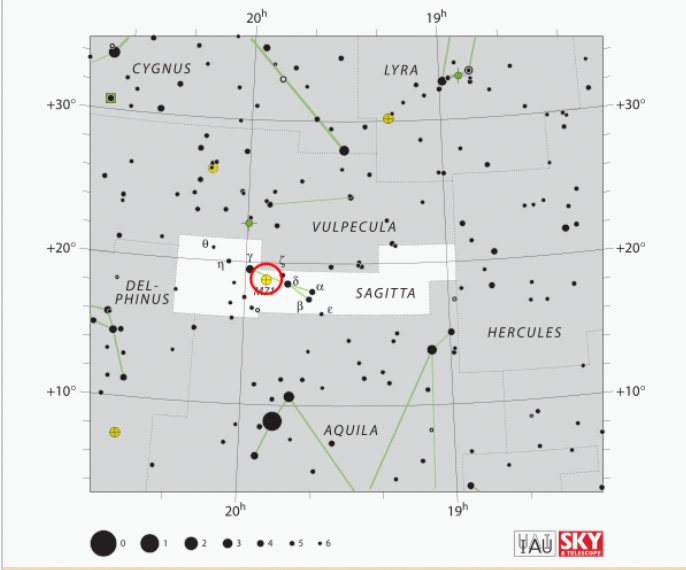
M 71 (also known as NGC 6838) is a very scattered and controversial globular cluster, visible in the constellation of Arrow. M71 is quite easy to locate, being located in the center of the small but characteristic constellation of Arrow, about 2° east of the star δ Sagittae, the central star of the constellation; it is barely visible with 8x30 or 10x50 binoculars, if the night is dark and clear. M71 can be easily observed from both hemispheres of the Earth, thanks to the fact that its declination is not excessively northern; from the northern regions it is more observable and appears extremely high in the sky on summer nights, while from the southern hemisphere it always remains lower on average, with the exception of areas close to the equator. It is however visible from all inhabited areas of the Earth. The best time to observe it in the evening sky is between June and November. M71 was discovered by Philippe Loys de Chéseaux in 1746 and included by Charles Messier in his catalogue in 1780; it was also observed by Koehler in Dresden around 1775. William Herschel was the first to resolve it into stars: he described it as a very rich and large cluster, whose components are between the eleventh and sixteenth magnitude. It was photographed for the first time in 1898 by Isaac Roberts from his private observatory. M71 is located at a distance of about 13,000 light-years from Earth and has an extension of only 27 light-years, very few for a globular cluster. The irregular variable star Z Sagittae is part of this cluster; it contains at least six M-type giants and its total luminosity is 13,200 solar luminosities. M71 was long considered (until 1970) to be a particularly concentrated open cluster. Its high radial velocity (-80 km/s) and its brightest stars, which are red, strongly support the classification of M71 as a globular cluster. On the contrary, the fact that no short-period variables such as the RR Lyrae variables have been discovered in it (which indicates a young age, about 9–10 billion years) and its location on the plane of the Milky Way are points in favor of its classification as an open cluster. The most recent sources agree in attributing to M71 the qualification of a globular cluster, although much less concentrated than M68 in Hydra.
|
|||