Click on the image for FULL RES |
||||
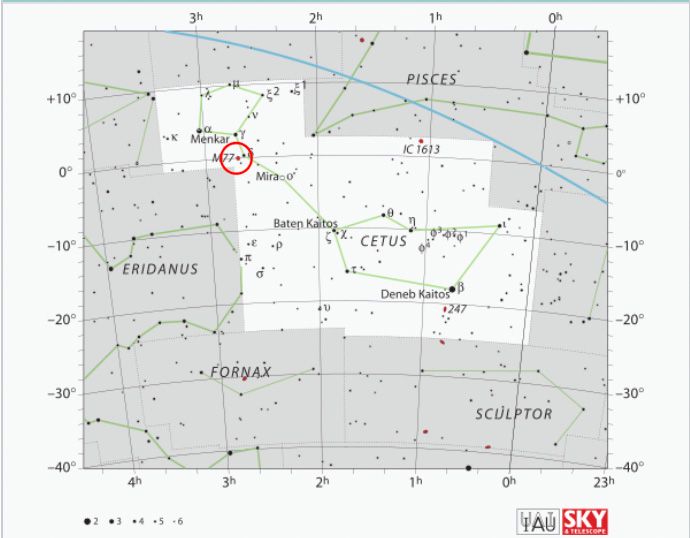
| Name / Constellation | M 77-NGC 1055 |
Other: NGC 1068, UGC 2188, PGC 10266 | Cet |
|
| Coordinates | AR: 02h 42m 40,7s - Dec: −00° 00′ 48″ | |||
| Optics | Astrophysics 130 EDFS f6 - Svbony 30/160mm guide scope + ZWO ASI 174 MM Mini | |||
| Camera-Mount | ZWO ASI 294 MC Pro - iOptron CEM40 Mount | |||
| Filters | Antlia Triband RGB Ultra | |||
|
||||
| Location / Date | Novara City (Italy) - Sept 2025 | |||
| Seeing | Bortle 7.6 | |||
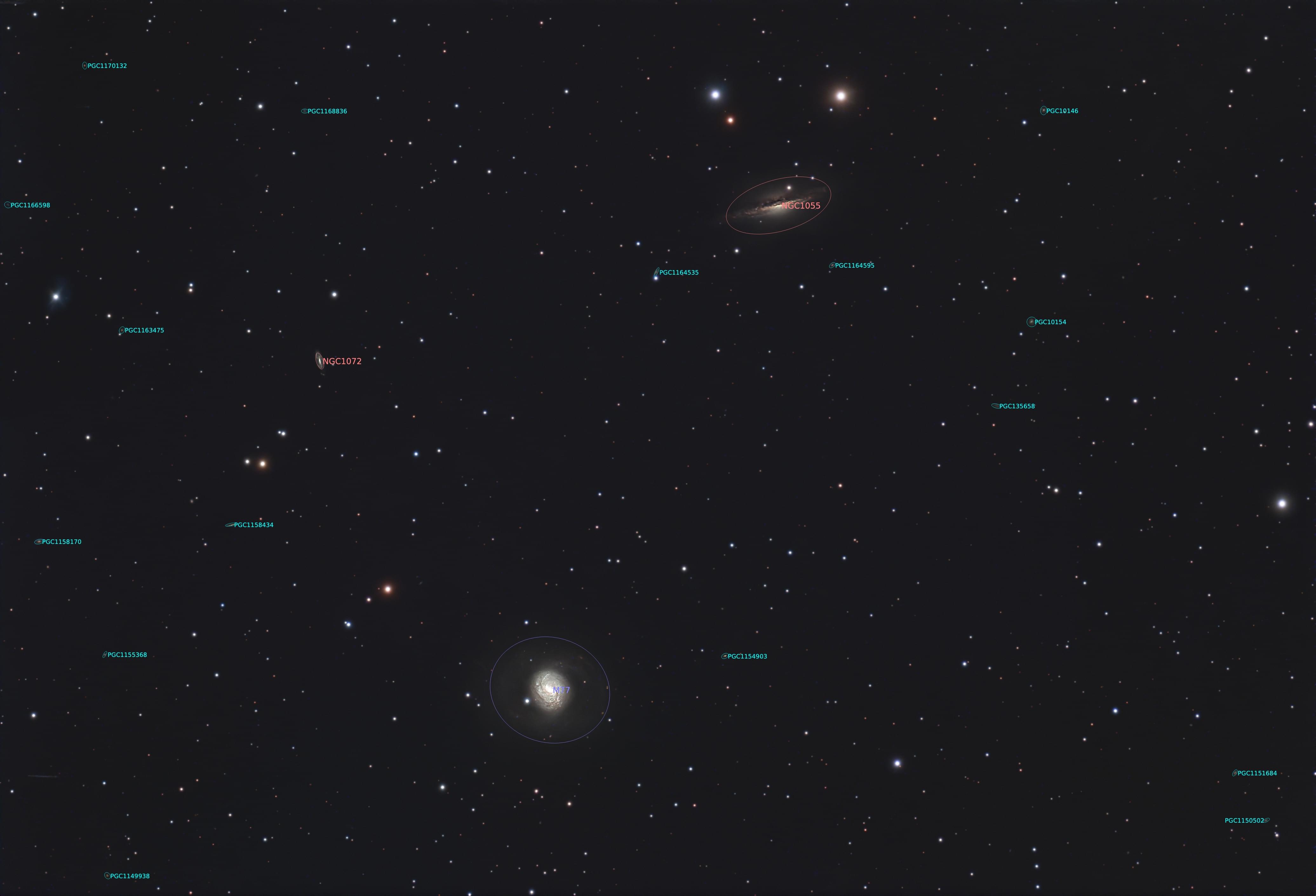
| Note | Many PGC galaxies untill 18mag (under urban high polluted sky!); SEE ANNOTATED IMAGE | |||
| Acquisition | N.I.N.A. | |||
| Processing | Adobe Photoshop -  |
|||
| Comment |
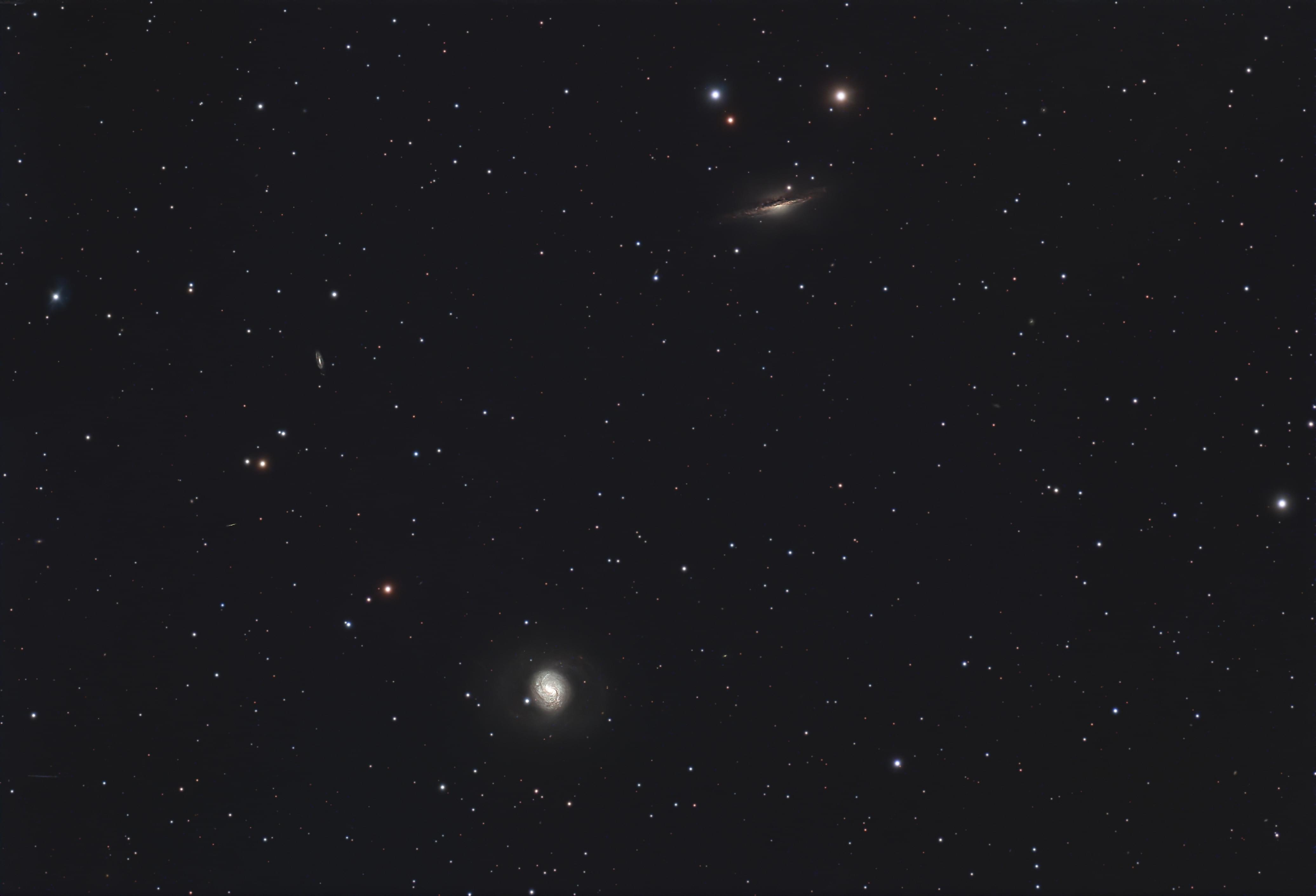
NGC 1055 and M77 are located in the same region of the celestial sphere and are two particularly sought-after subjects for astrophotography. The best time to photograph them is during the month of September, when they are low on the horizon in the Northern Hemisphere. Garcia classifies NGC 1055 as belonging to the NGC 1068 Group or M77 Group. This galaxy group contains at least seven members, including M77 (NGC 1068), NGC 1073, UGC 2162, UGC 2275, UGC 2302, and UGCA 44. M77 (also known as NGC 1068) is a spiral galaxy visible in the constellation Cetus. M77 is about 47 million light-years away; it is an active galaxy whose nucleus is obscured at visible wavelengths by interstellar dust. The diameter of the molecular disk and the hot plasma associated with the obscuring matter were initially measured at radio waves; The hot dust around the nucleus was later measured by the Very Large Telescope. It is the brightest Seyfert galaxy and is a type 2. Its diameter is estimated to be 170,000 nm. NGC 1055 is a relatively nearby, edge-on barred spiral galaxy located in the constellation Cetus, approximately 37 million light-years from our Milky Way.The galaxy was discovered on December 18, 1783, by the German-born British astronomer William Herschel. NGC 1055 has a luminosity class II and displays a broad 21-cm line of neutral hydrogen. It was used by Gérard de Vaucouleurs as an example of a "Sab sp" type galaxy in his morphological classification atlas of galaxies. It is considered an active galaxy of the Seyfert 2 (Sy 2) type.
|
|||