Click on the image for FULL RES |
||||
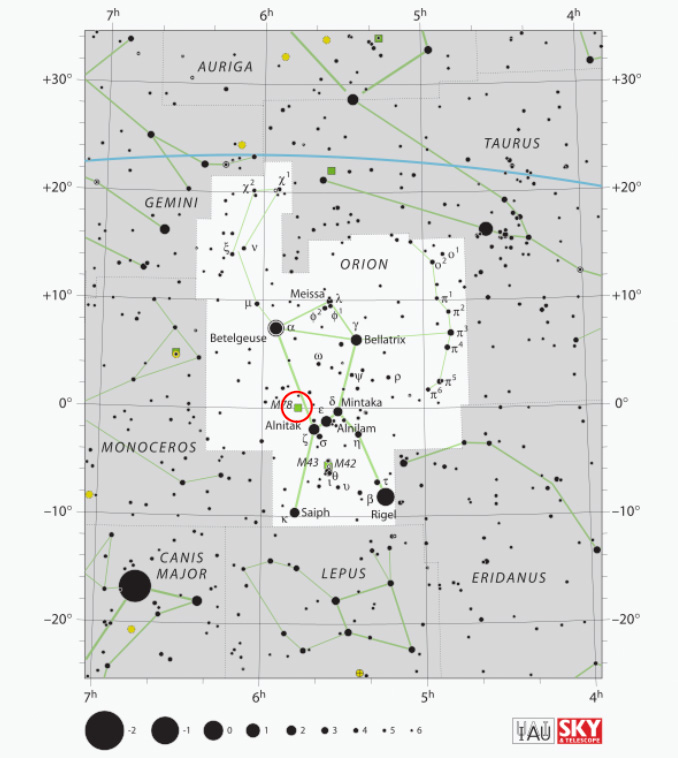
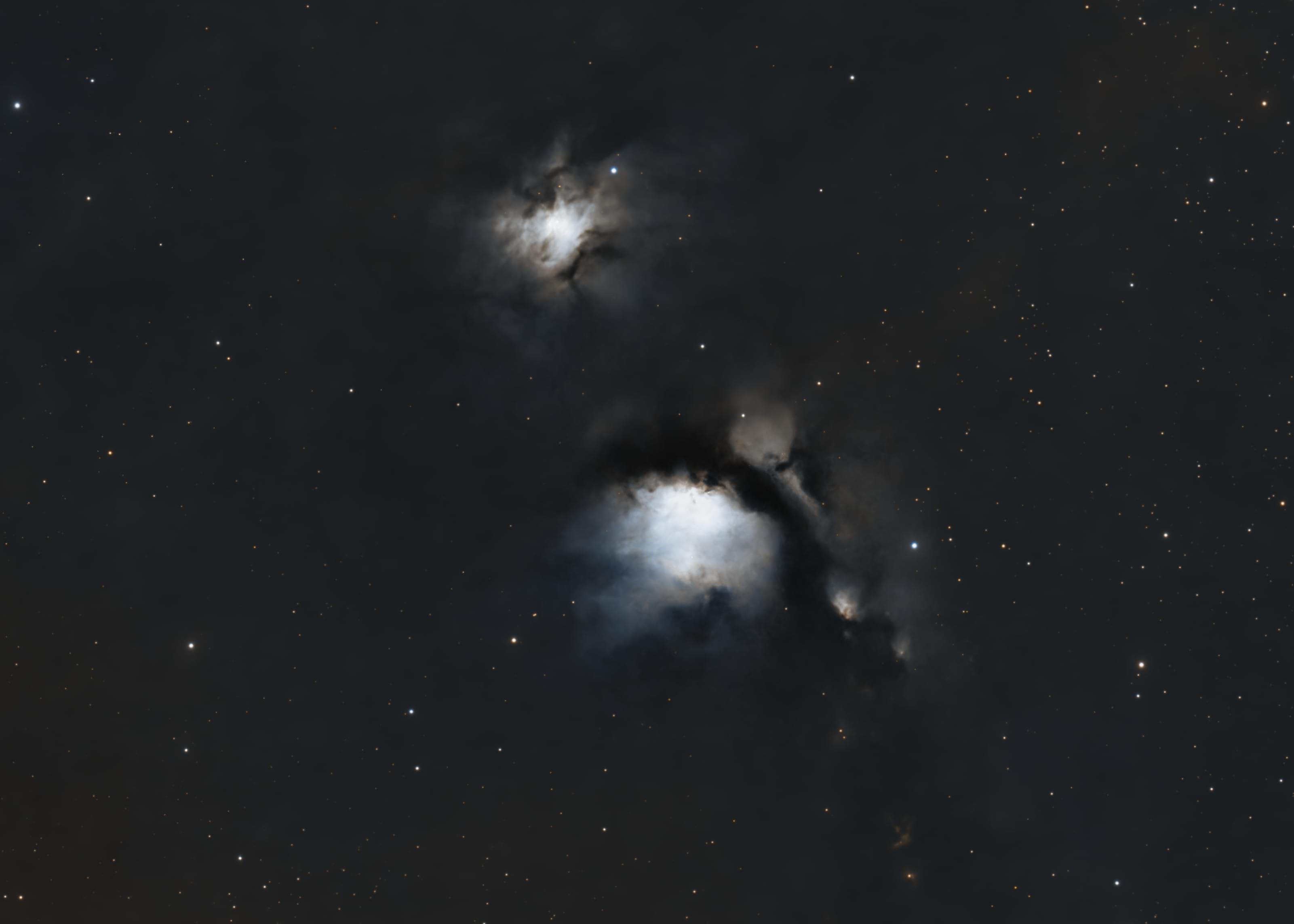
| Name / Constellation | M 78 |
Other: NGC 2068, Ced 55u, vdB 59 | Ori |
|
| Coordinates | AR: 05h 46m 45.8s - Dec: +00° 04′ 45″ | |||
| Optics | Astrophysics 130 EDFS f6 - Svbony 30/160mm guide scope + ZWO ASI 174 MM Mini | |||
| Camera-Mount | ZWO ASI 294 MC Pro - iOptron CEM40 Mount | |||
| Filters | Antlia Triband RGB Ultra | |||
|
||||
| Location / Date | Novara City (Italy) - Sept 2025 | |||
| Seeing | Bortle 7.6 | |||
| Note | ||||
| Acquisition | N.I.N.A. | |||
| Processing | Adobe Photoshop -  |
|||
| Comment |
M 78 (also known as NGC 2068) is a diffuse nebula visible in the constellation of Orion. Discovered by Pierre Méchain in 1780, it was included by Charles Messier in his famous catalog of astronomical objects that same year. M78 can be observed from both hemispheres of the Earth, thanks to its virtually equatorial position: the object reaches the same altitude in the sky from every pair of opposite latitudes (for example, 30°N and 30°S), so neither hemisphere is better for observation than the other. The best time to spot it in the evening sky is between November and April. M78 is the brightest reflection nebula in the sky; it is part of a group of nebulae that includes NGC 2064, NGC 2067, and NGC 2071, 1,600 light-years from Earth. The two stars illuminating the dust cloud in M78 are cataloged as HD 38563A and HD 38563B and are magnitude 10; the actual extent of the nebula is approximately 4 light-years. There are approximately 45 T Tauri variable stars, young stars in formation, as well as 17 Herbig-Haro objects within M78. It is part of the Orion Molecular Cloud Complex and is merely a fragment of the gas present in this region, illuminated by nearby stars. Just southwest of M78, in a very darkened region of the LDN 1630 complex, three connected HH objects, catalogued as HH 24, HH 25 and HH 26, can be observed; this section of the cloud has a complex morphology due to the intense star formation that takes place here. As a consequence, the region is rich in young stellar objects, among which two very young class 0 protostars have been identified,[4] the class 1 protostar HH26IR, with strong infrared emission, and four additional infrared sources reobserved by IRAS and already known in the 1970s,[6] which have luminosities between 15 and 25 L☉. From the gaseous cocoons of the two class 0 protostars emerge very dense jets of material along whose axes are beams of molecular hydrogen; the cores of the cocoons are similarly very dense. In January 2004, the star V1647 Orionis, a young eruptive variable star located on the northwestern edge of the cloud, experienced a sudden peak in brightness, illuminating a portion of the cloud's gases, which was named McNeil's Nebula after its discoverer. This event was of considerable importance in the study of the dynamics related to young pre-main sequence stars and was intensively studied for two years, corresponding to the period in which it maintained a brightness above normal; in October 2005, its brightness dropped sharply.
|
|||