Click on the image for FULL RES |
||||
| Name / Constellation | M 90 |
Other: NGC 4569, UGC 7786, PGC 42089, Arp 76 | Vir |
|
| Coordinates | AR: 12h 36m 49,8s, +13° 09′ 46″ | |||
| Optics | Officina Stellare 10" f8 Richtey-Cretien | |||
| Camera-Mount | PLAYERONE POSEIDON M-PRO - ZWO ASI 1600M (ONAG)- 10Micron GM2000 QCI Mount | |||
| Filters | Antlia V-Pro LRGB | |||
| Exposure |
|
|
|
|
| Location / Date | Promiod (Valle D'Aosta-Italy) "TLP" Remote Observatory - Feb/Mar 2024 | |||
| Seeing | 2.8" @ 1.17 arcosec/pixel binning 3 | |||
| Note | Drizzle 2X in postprocessing (Pixinsight)) | |||
| Acquisition | N.I.N.A. | |||
| Processing | Adobe Photoshop CC -  |
|||
| Comment |
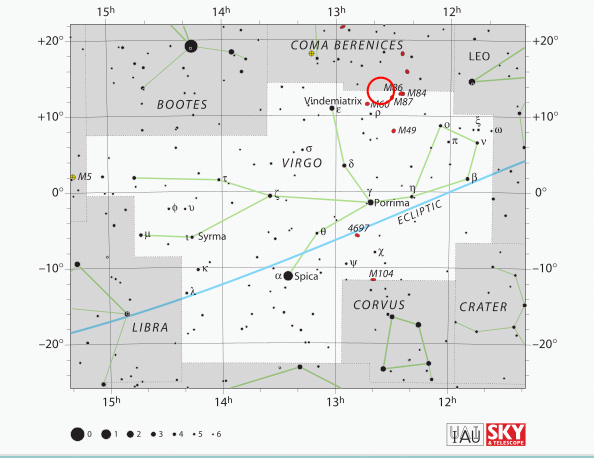
M 90 (also known as NGC 4569) is a spiral galaxy visible in the constellation of Virgo; it is one of the eight galaxies found and catalogued by Charles Messier on 18 March 1781 in the Coma-Virgo region, together with the globular cluster M92 of Hercules. M90 is located in a region of the sky without reference stars, between the constellations of Virgo and Coma Berenices; it is one of the brightest galaxies of the Virgo group. M90 was first described by Charles Messier in 1781 as a starless nebula; William Herschel indicated it as a large and bright spot in the center, where there is a well-defined nucleus. The most accurate description comes from Father Heinrich Ludwig d'Arrest, who described it as an elliptical cloud whose nucleus shines like a twelfth magnitude star, of which it would also possess the appearance; its dimensions are 7' x 2'. M90 is one of the largest spiral galaxies (9.5x4.5') of the Virgo Cluster. It has spiral arms, very narrow and uniformly bright, which appear to be completely "fossilized", in the sense that there does not seem to be any star formation in progress, with the sole exception of the inner region of the disk, near some dark lines of dust. Its interstellar medium has probably been largely stripped away by the intense tidal forces present within the cluster in which it is located; other theories suggest that it was swept away by multiple supernova explosions in the core region, where star formation is still active. J.D. Wray has proposed that this galaxy is evolving toward a state similar to that of M64, and then becoming a lenticular system (S0). Its distance is approximately 60 million light-years and it has an apparent magnitude of 9.3. Since it is approaching us at a speed of 383 km/s, it must be moving at a particularly high speed, close to 1,500 km/s, through the Virgo Cluster in our direction, and it is possible that it is on the verge of escaping from the cluster; according to some sources it has already left the cluster and is now much closer to us. Only one other Messier galaxy, M86, has a faster approach velocity.
|
|||