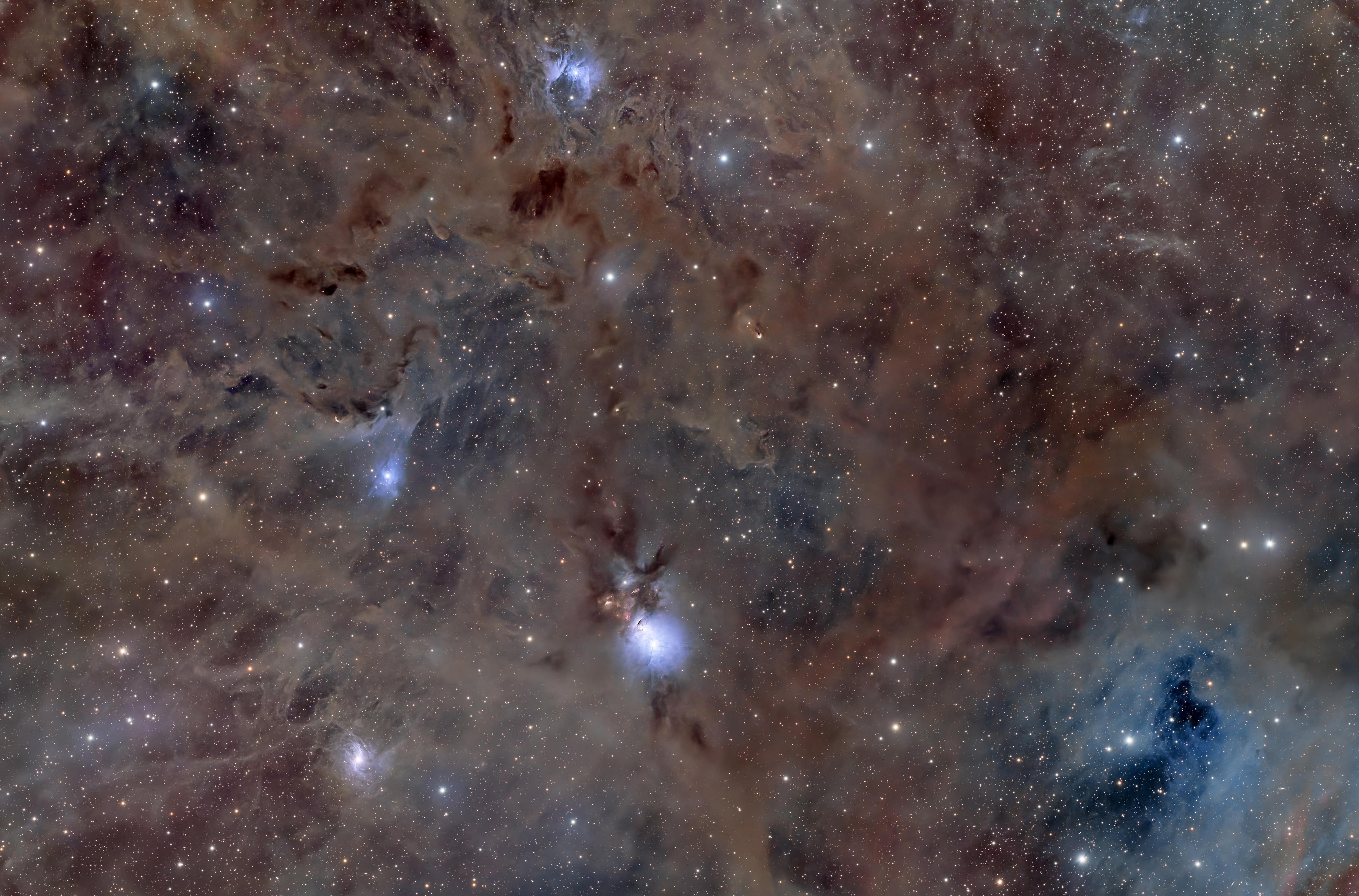
Click on the image for FULL RES |
||||
| Name / Constellation | NGC 1333 |
Other: Ced 16, GN 03.26.1, LBN 741, Embryo Nebula | Per |
|
| Coordinates | AR: 03h 29m 11.3s - Dec: +31° 18′ 36″ | |||
| Optics | Takahashi FSQ 106N APO Fluorite F5 | |||
| Camera-Mount | ZWO ASI 2400 MC Pro - ZWO ASI174Mini Guider (OAG)- 10Micron GM2000 QCI Mount | |||
| Filters | IDAS LPS-D3 | |||
| Exposure |
|
|||
| Location / Date | Promiod (Valle D'Aosta-Italy) "TLP" Remote Observatory - Ago/Sept 2022 | |||
| Seeing | About 2.8" @ 2.3 arcosec/pixel unbinned | |||
| Note | ||||
| Acquisition | NINA | |||
| Processing | Adobe Photoshop -  |
|||
| Comment | NGC 1333 is a reflection nebula located in the northern constellation Perseus, positioned next to the southern constellation border with Taurus and Aries.[3] It was first discovered by German astronomer Eduard Schönfeld in 1855.[4] The nebula is visible as a hazy patch in a small telescope, while a larger aperture will show a pair of dark nebulae designated Barnard 1 and Barnard 2.[5] It is associated with a dark cloud L1450 (Barnard 205). Estimates of the distance to this nebula range from 980–1,140 ly (300–350 pc).[4] | |||