|
| Name / Constellation |
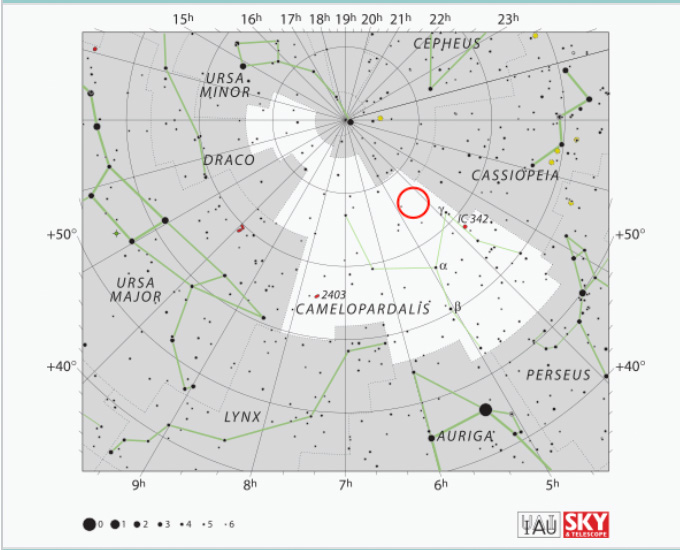
NGC 1530 |
Other: PGC15018, UGC3013, MCG13-4-4 |
Cam |
| Coordinates |
AR: 04h 23m 27.1s , +75° 17′ 44″ |
| Optics |
Officina Stellare 10" f8 Richtey-Cretien |
| Camera-Mount |
PLAYERONE POSEIDON M-PRO - ZWO ASI 1600M (ONAG)- 10Micron GM2000 QCI Mount |
| Filters |
Antlia V-Pro LRGB |
| Exposure |
|
- 101 x 300 sec - 8 hours 45min
- 36 x 300 sec - 3 hours
- 36 x 300 sec - 3 hours
- 36 x 300 sec - 3 hours
|
- Binning 3
- Binning 3
- Binning 3
- Binning 3
|
| Location / Date |
Promiod (Valle D'Aosta-Italy) "TLP" Remote Observatory - Nov 2024 |
| Seeing |
2.4" @ 1.17 arcosec/pixel binning 3 |
| Note |
Drizzle 2X in postprocessing (Pixinsight)) |
| Acquisition |
N.I.N.A. |
| Processing |
Adobe Photoshop CC -  |
| Comment |
NGC 1530 is a barred spiral galaxy located in the constellation of Camelopardalis, at a distance of about 115 million light-years from our Milky Way.
The galaxy was discovered in 1876 by the German astronomer Wilhelm Tempel.
NGC 1530 was used by Gérard de Vaucouleurs as an example of a galaxy of the morphological type "SB(rs)b" in his atlas of galaxies.
NGC 1530 has a luminosity class II and presents a broad 21 cm line of neutral hydrogen. Furthermore, it is a field galaxy, that is, a galaxy that does not belong to any cluster or group of galaxies and is therefore gravitationally isolated.
Given its surface brightness of 14.10, NGC 1530 can be classified as a galaxy with low surface brightness (abbreviated in the English literature as LSB, acronym for Low Surface Brightness). LSB galaxies are diffuse-type (D) galaxies with a surface brightness at least one magnitude less than that of the surrounding night sky.
|
