Click on the image for FULL RES |
||||
| Name / Constellation | NGC 1560 |
Other: IC 2062, ZWG 328.6, CGCG 328-6, MCG 12-5-5, UGC 3060, PGC 15488 | Cam |
|
| Coordinates | AR: 04h 32m 49s, +71° 52′ 59″ | |||
| Optics | Officina Stellare 10" f8 Richtey-Cretien | |||
| Camera-Mount | PLAYERONE POSEIDON M-PRO - ZWO ASI 1600M (ONAG)- 10Micron GM2000 QCI Mount | |||
| Filters | Antlia V-Pro LRGB | |||
| Exposure |
|
|
|
|
| Location / Date | Promiod (Valle D'Aosta-Italy) "TLP" Remote Observatory - Jan/Feb 2024 | |||
| Seeing | 2.6" @ 1.17 arcosec/pixel binning 3 | |||
| Note | Drizzle 2X in postprocessing (Pixinsight)) | |||
| Acquisition | N.I.N.A. | |||
| Processing | Adobe Photoshop CC -  |
|||
| Comment |
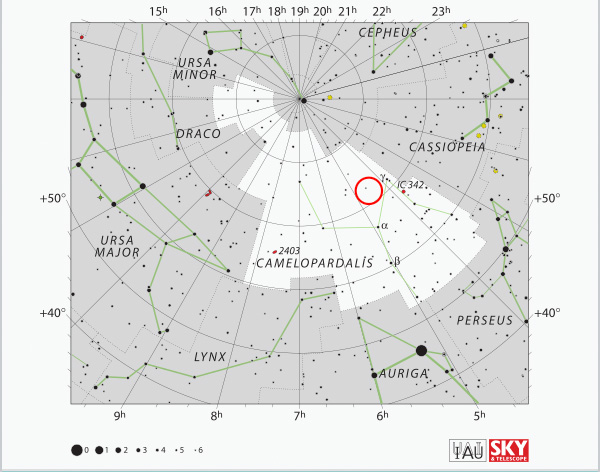
NGC 1560, also known as IC 2062, is a spiral galaxy (SA(s)d HII) of 11th magnitude, located in the direction of the constellation of Camelopardalis in the Maffei 1 group of galaxies (or IC 342/Maffei Group). It was discovered on August 1, 1883 by Wilhelm Tempel. Its distance is not well known because it is quite close to Earth and its distance cannot be calculated based on the redshift. Its radial velocity is negative (- 35 km/s). Karachentsev et al. (2003) estimate a distance of 11.2 million light-years (3.45 Megaparsecs), while Lee and Madore (1993), with the brightest stars method, estimated the distance at 8.1 million light-years (2.5 Megaparsecs). The most accurate estimate is currently considered to be between 8 and 12 million light years. Although quite close to Earth, this galaxy is not part of the Local Group. Its width is estimated at about 35,000 light years (apparent size of 11.6 x 9.1 arcmin).
|
|||