Click on the image for FULL RES |
||||
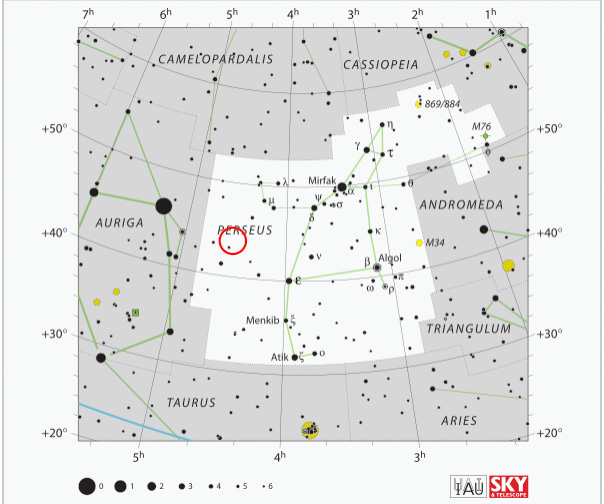
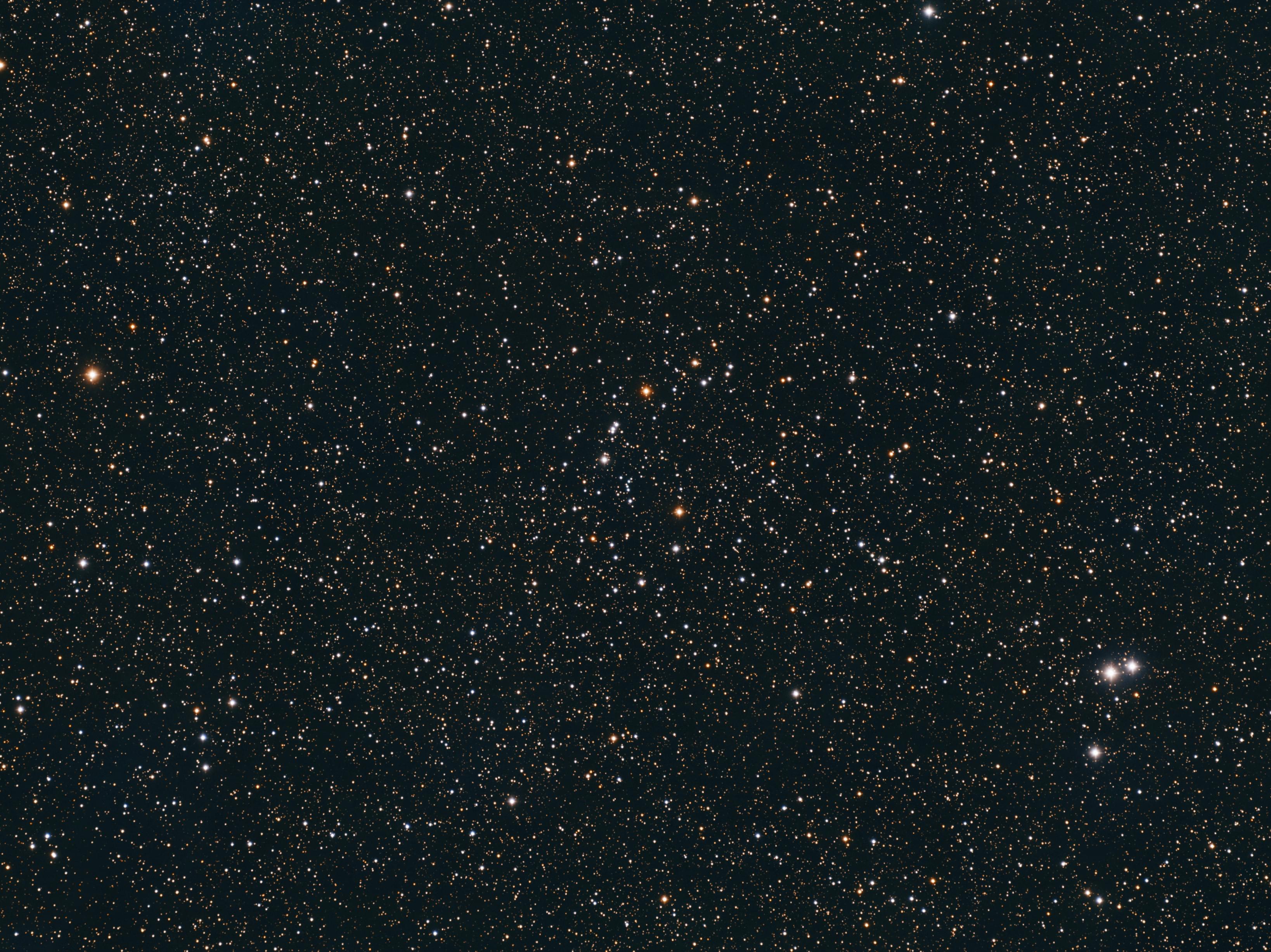
| Name / Constellation | NGC 1582 |
Other: C 10, Cr 20, Mel 11,OCL 333, Lund 55, H VI-31, GC 392 | Per |
|
| Coordinates | AR: 04h 31m 54 - Dec: +43° 49′ 00″ | |||
| Optics | Takahashi FSQ 106N APO Fluorite F5 - 60/220 guiding refractor | |||
| Camera-Mount | SBIG STF8300M - Orion StarShot Guider - 10Micron GM2000 QCI Mount | |||
| Filters | Baader LRGB | |||
| Exposure |
|
|
|
|
| Location / Date | Promiod (Valle D'Aosta-Italy) "TLP" Remote Observatory - Genn 2021 | |||
| Seeing | About 2.8" @ 2.1 arcosec/pixel unbinned | |||
| Note | ||||
| Acquisition | MaxIm DL - CCD Autopilot 5 | |||
| Processing | Adobe Photoshop -  |
|||
| Comment |
NGC 1582 is a very scattered cluster with relatively few stars, although it is large in both apparent and real dimensions; its distance is estimated at around 1100 parsecs (3586 light years), corresponding to a region probably located on the outer edge of the Orion Arm or near the innermost edge of the Perseus Arm, near a concentration of young stars that together with other more distant stellar groups is traditionally referred to as Auriga OB1. The main difficulty encountered in studying this object is its considerable dispersion, especially in relation to the rather rich star fields that are found in its direction; its age of around 300 million years makes it a relatively evolved object, although not particularly old. Two probable binary stars have been identified among its components.
|
|||