Click on the image for FULL RES |
||||
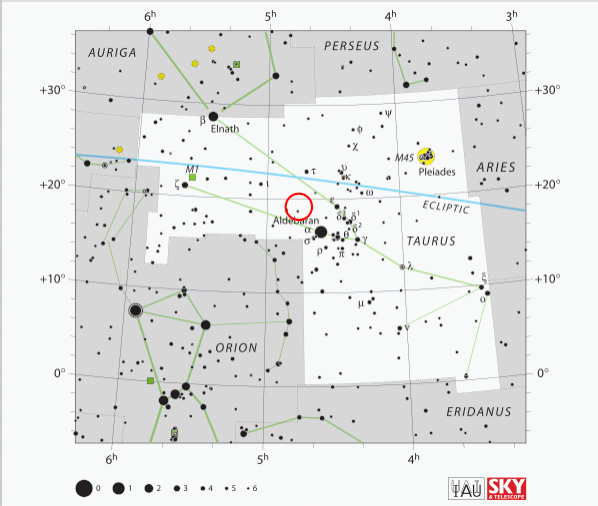
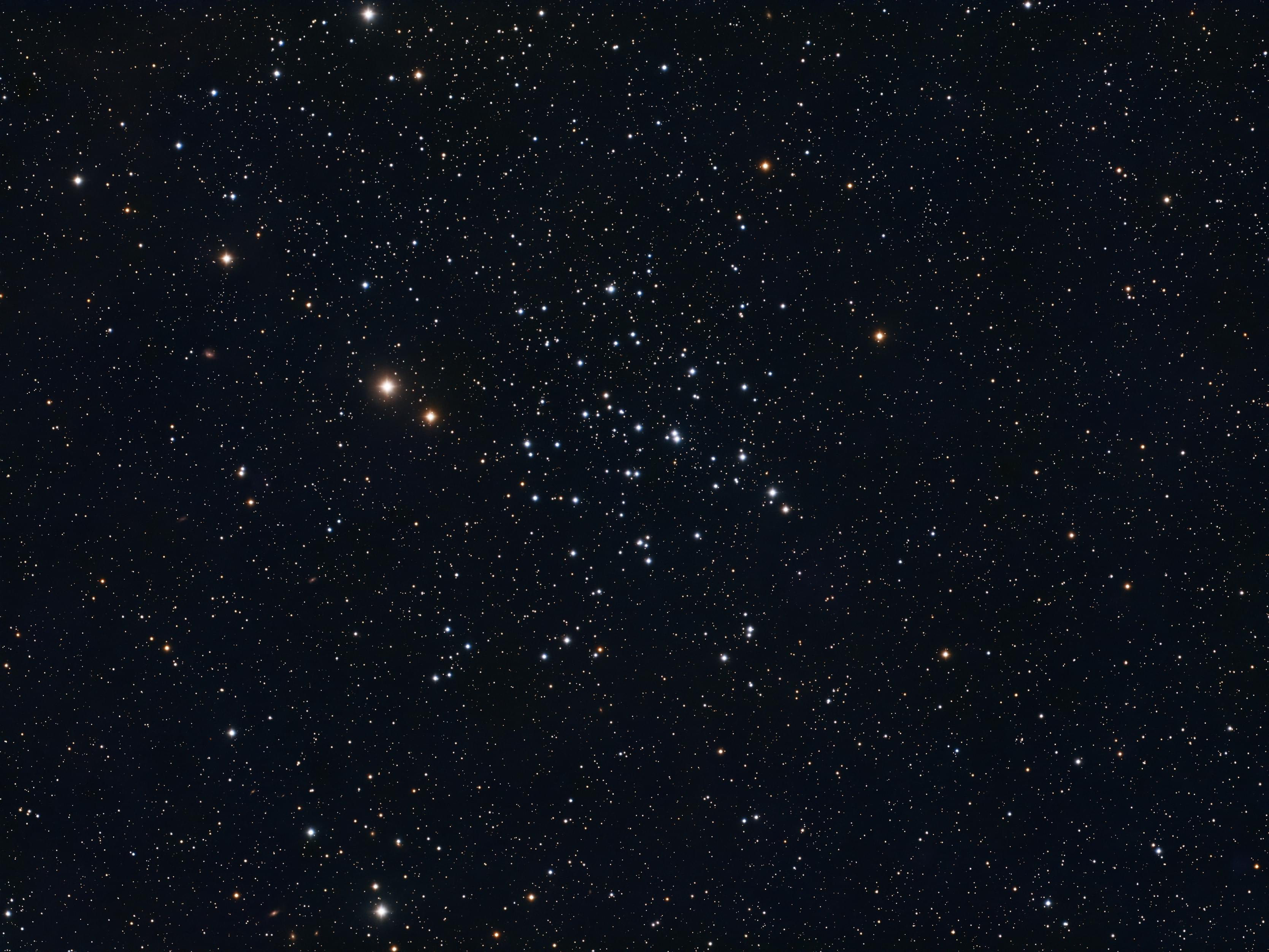
| Name / Constellation | NGC 1647 |
Other: Mel 26; Cr 54; OCl 457[ | Tau |
|
| Coordinates | AR: 04h 45m 54s - Dec: +19° 06′ 00″ | |||
| Optics | Takahashi FSQ 106N APO Fluorite F5 - 60/220 guiding refractor | |||
| Camera-Mount | SBIG STF8300M - Orion StarShot Guider - 10Micron GM2000 QCI Mount | |||
| Filters | Baader LRGB | |||
| Exposure |
|
|
|
|
| Location / Date | Promiod (Valle D'Aosta-Italy) "TLP" Remote Observatory - Genn 2021 | |||
| Seeing | About 2.8" @ 2.1 arcosec/pixel unbinned | |||
| Note | ||||
| Acquisition | MaxIm DL - CCD Autopilot 5 | |||
| Processing | Adobe Photoshop -  |
|||
| Comment |
NGC 1647 is located in our spiral arm of the Milky Way, the Orion Arm, at a distance of about 540 parsecs (1760 light years), that is, on the external part with respect to the galactic center (we are instead on the internal edge), beyond the Taurus Cloud, an extensive system of dark nebulae whose offshoots overlap the line of sight; therefore NGC 1647 is partially obscured by them. The cluster contains almost 200 stars, of which about thirty up to magnitude 11, spread over a diameter of 45'. Numerous member stars lie in regions far from the nucleus, forming a sort of corona; among these components there is also SZ Tauri, a Cepheid variable with a period of 3.15 days. Another notable component is a binary star formed by two red dwarfs, whose masses have been estimated to be around 0.45 and 0.19 M⊙; unlike other systems of this type, the two red dwarfs have very different masses from each other, which provides an opportunity to test models of the stellar evolution of these systems.
|
|||