Click on the image for FULL RES |
||||
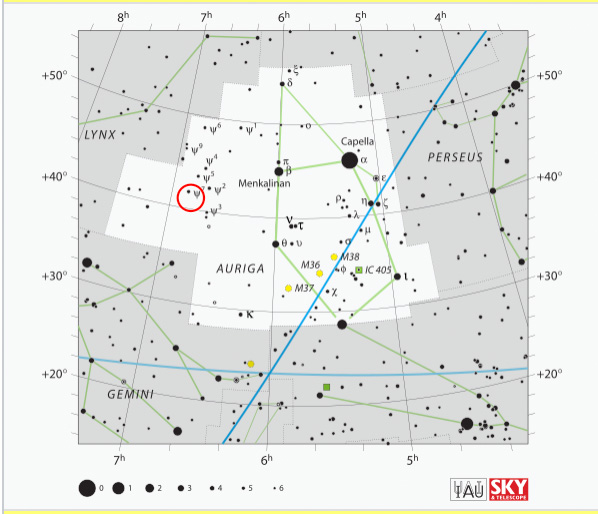
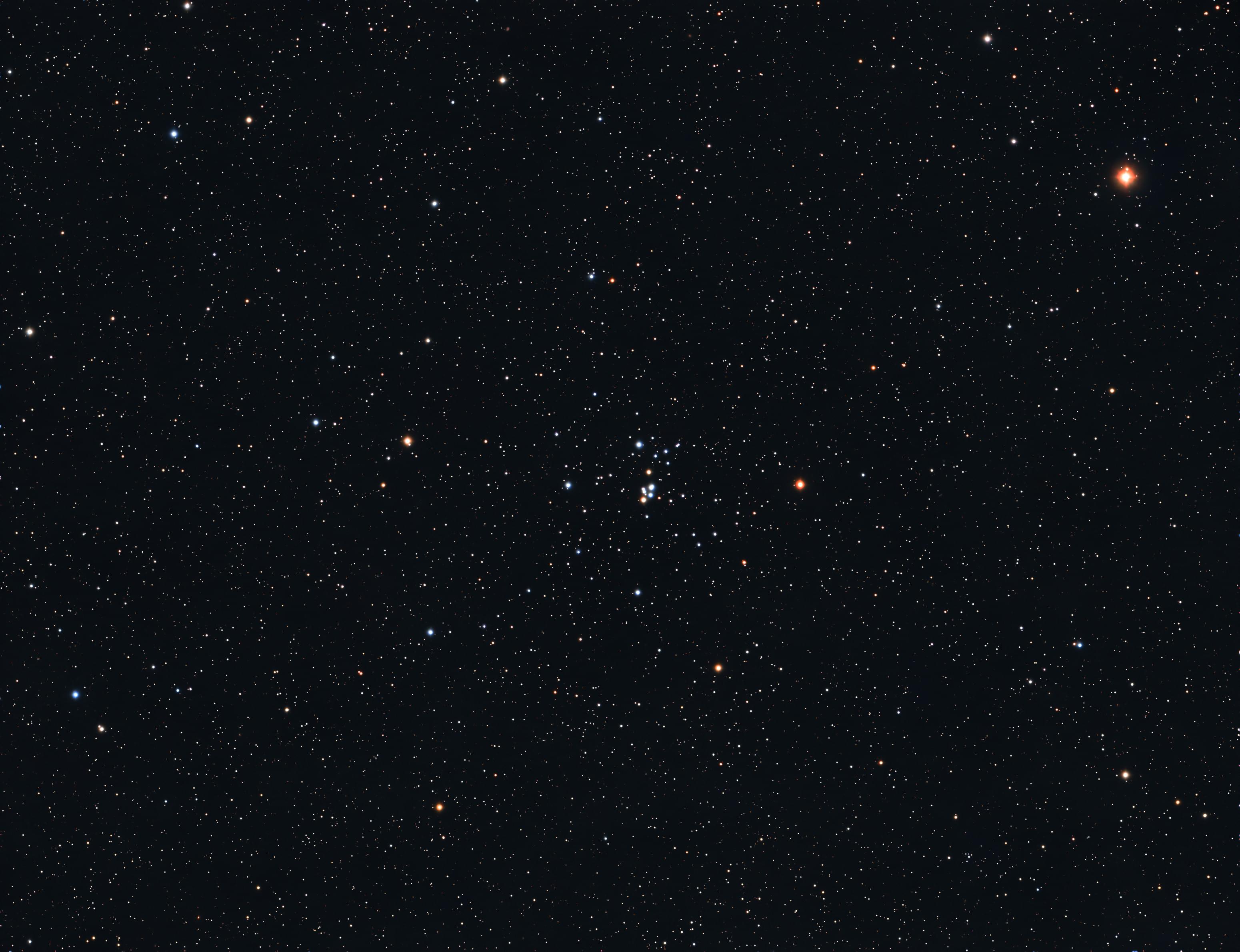
| Name / Constellation | NGC 2281 |
Other: el 51; Cr 116; OCl 446 | Aur |
|
| Coordinates | AR: 06h 48m 17s - +41° 04′ 42″ | |||
| Optics | Takahashi FSQ 106N APO Fluorite F5 - 60/220 guiding refractor | |||
| Camera-Mount | SBIG STF8300M - Orion StarShot Guider - 10Micron GM2000 QCI Mount | |||
| Filters | Baader LRGB | |||
| Exposure |
|
|
|
|
| Location / Date | Promiod (Valle D'Aosta-Italy) "TLP" Remote Observatory - Genn 2021 | |||
| Seeing | About 2.8" @ 2.1 arcosec/pixel unbinned | |||
| Note | ||||
| Acquisition | MaxIm DL - CCD Autopilot 5 | |||
| Processing | Adobe Photoshop -  |
|||
| Comment |
NGC 2281 is a rather poor cluster, although well contrasted with respect to the background star fields; located at a distance of 558 parsecs (1820 light years), it falls within the Orion Arm, in a region located just beyond the Perseus Cloud. It lies at a high galactic latitude, almost 17° from the galactic equator. Two of its main components have spectral class K, that is, they are red giant stars near the end of their life cycle, which highlights that the cluster is already quite evolved; its age is in fact equal to 360 million years, or about two thirds of the age of the Hyades or the Praepe. To these is added a yellow giant of class G8. The turnoff point in the main sequence of the stars of the cluster is A0; This means that there are no main sequence stars of class O and B. Unlike many open clusters, there is no apparent concentration towards the center.
|
|||