Click on the image for FULL RES |
||||
| Name / Constellation | NGC 2336 |
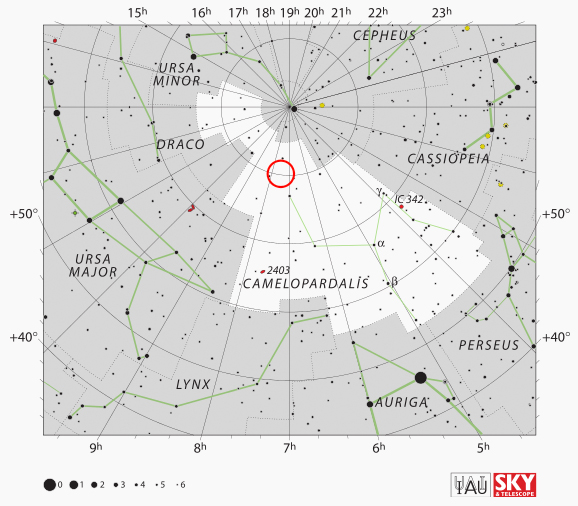
Other: UGC 3809, MCG +13-06-006, PGC 21033 | Cam |
|
| Coordinates | AR: 07h 27m 04.1s - Dec: +80° 10′ 41″ | |||
| Optics | Officina Stellare 10" f8 Richtey-Cretien | |||
| Camera-Mount | SBIG ST10XME/CFW10 - ZWO ASI1600MM guider (ONAG) - 10Micron GM2000 QCI Mount | |||
| Filters | Astrodon Gen. II - LRGB | |||
| Exposure |
|
|
|
|
| Location / Date | Promiod (Valle D'Aosta-Italy) "TLP" Remote Observatory - 12/18 dec 2020 | |||
| Seeing | 2.4" @ 0.7 arcosec/pixel unbinned | |||
| Note | ||||
| Acquisition | MaxIm DL - CCD Autopilot5 - CCDCommander | |||
| Processing | Adobe Photoshop -  |
|||
| Comment | NGC 2336 is a spiral galaxy located in the constellation Camelopardalis. It is located at a distance of circa 100 million light years from Earth, which, given its apparent dimensions, means that NGC 2336 is about 200,000 light years across. It was discovered by Wilhelm Tempel in 1876. NGC 2336 is a barred spiral galaxy, featuring a small optical bar. At least 8 spiral arms, with numerous HII regions, emanate from the ring-like structure around the bar. This ring has a radius of approximately 34 arcseconds, which corresponds to 5.3 kpc at the distance of NGC 2336. In the large arms of the galaxy have been observed 28 HII regions that may host young massive star clusters, and for two of them the nebular emission comprises most of the flux. Three of these HII areas have ages calculated to be 100 to 300 million years and have sizes between 300 and 600 parsecs. It is suggested they are star complexes that may coexist with younger ones. The most massive of the HII regions, number 13, has a mass estimated to be (550±169)×104 M☉ and is 2,600 ly (810 pc) across. Observations in the ultraviolet showed 78 star forming regions, with two them between the spiral arms and six at the galaxy ring. Their size is comparable to NGC 604, one of the largest nebulae in the Local Group. Star formation is more intense in the inner parts of the arms and at the ring.
|
|||