|
| Name / Constellation |
NGC 2366 |
Other: PGC 21102; UGC 3851; MCG 12-7-40; KCPG 133B; DDO 42; CGCG 330-38; MK 71; IRAS 07233+6917 |
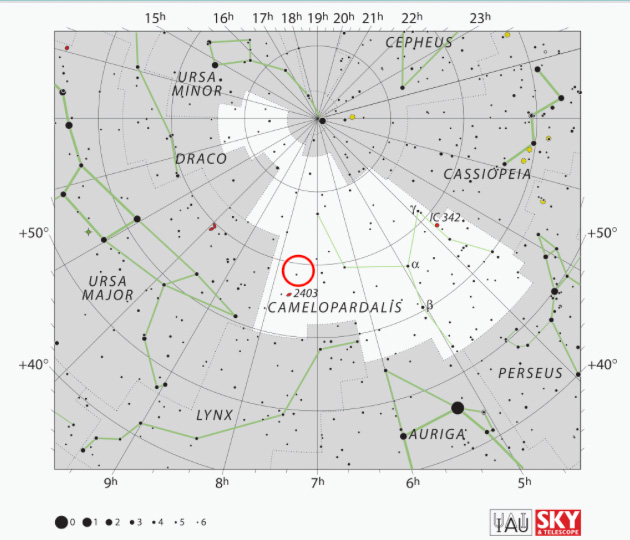
Cam |
| Coordinates |
AR: 07h 28m 51,1s , +69° 12′ 31″ |
| Optics |
Officina Stellare 10" f8 Richtey-Cretien |
| Camera-Mount |
PLAYERONE POSEIDON M-PRO - ZWO ASI 1600M (ONAG)- 10Micron GM2000 QCI Mount |
| Filters |
Antlia V-Pro LRGB |
| Exposure |
- Luminance
- Ha
- Red
- Green
- Blue
|
- 130 x 300 sec - 10 h 50m
- 81 x 388 sec - 6h 45m
- 22 x 300 sec - 1 h 50m
- 24 x 300 sec - 2 h
- 30 x 300 sec - 2 h 30m
|
- Binning 3
- Binning 3
- Binning 3
- Binning 3
- Binning 3
|
| Location / Date |
Promiod (Valle D'Aosta-Italy) "TLP" Remote Observatory - Dic 2025 |
| Seeing |
2.7" @ 1.17 arcosec/pixel binning 3 |
| Note |
Drizzle 2X in postprocessing (Pixinsight)) |
| Acquisition |
N.I.N.A. |
| Processing |
Adobe Photoshop CC -  |
| Comment |
NGC 2366 is a Magellanic barred irregular dwarf galaxy located in the constellation Camelopardalis.
At the southern end of NGC 2366 is the large, luminous HII region known as Markarian 71 (Mrk 71). To the west of Mrk 71 is another dwarf galaxy NGC 2363 which is interacting with NGC 2366. There has been confusion about the various components of NGC 2366 and its neighbouring galaxy NGC 2363. Corwins' notes remark that there are two galaxies with two NGC numbers clearly attached to each one: We shall just have to get used to calling the HII region "Markarian 71" (or one of its other names) since it is not N2363 as we've thought all these years.
Within Mrk 71, there are two super star clusters (SSC) which are named 'A' and 'B' or 'Knot A' and 'Knot B'.
Other names for the above components include: NGC 2366-I, NGC 2366-II, NGC 2366-III, NGC2366-A, NGC 2366-B, NGC 2366-C, NGC 2363-A, NGC 2363-B. NGC 2366 is an outlying member of the M81 Group.
|
