Click on the image for FULL RES |
||||
| Name / Constellation | NGC 2372 |
Other: UGC 7772, PGC 42038, Caldwell 38 | Gem |
|
| Coordinates | AR: 07h 25m 34,7s - Dec: +29° 29′ 25,6″ | |||
| Optics | Officina Stellare 10" f8 Richtey-Cretien | |||
| Camera-Mount | SBIG ST10XME/CFW10 - ZWO ASI1600MM guider (ONAG) - 10Micron GM2000 QCI Mount | |||
| Filters | Astrodon Gen. II - LRGB | |||
| Exposure |
|
|
|
|
| Location / Date | Promiod (Valle D'Aosta-Italy) "TLP" Remote Observatory - feb 2022 | |||
| Seeing | 2.8" @ 0.7 arcosec/pixel unbinned | |||
| Note | IDAS NBN-PV filter / Astrodon LRGB Gen II filters | |||
| Acquisition | MaxIm DL - CCDAutopilot | |||
| Processing | Adobe Photoshop CC -  |
|||
| Comment |
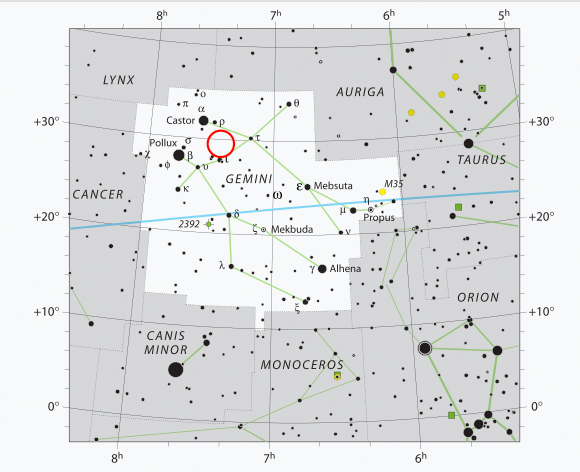
NGC 2371-2 is a dual lobed planetary nebula located in the constellation Gemini. Visually, it appears like it could be two separate objects; therefore, two entries were given to the planetary nebula by John Louis Emil Dreyer in the New General Catalogue, so it may be referred to as NGC 2371, NGC 2372, or variations on this name. It has also been called the double bubble nebula. The central star of the planetary nebula has a spectral type of [WO1], indicating a spectrum similar to that of an oxygen-rich Wolf–Rayet star. At 13th magnitude, this nebula is well within the limits of most amateur telescopes. Like most planetary nebulae, this one responds well to both high magnification and narrow-band filters, especially an OIII emission filter. It is listed within the RASC's 110 Finest NGC List.
|
|||