Click on the image for FULL RES |
||||
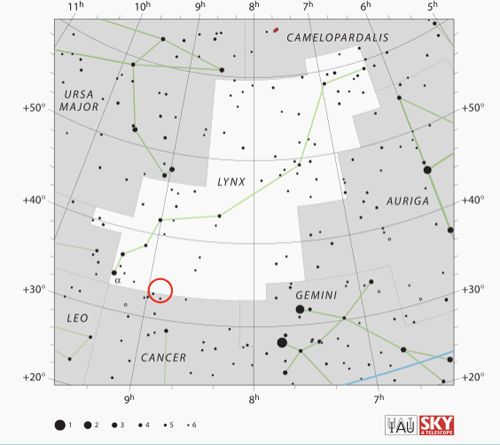
| Name / Constellation | NGC 2683 |
Other: UGC 4641; PGC 24930; Gc 1713; CGCG180.017; MCG+06-20-011 | Lyn |
|
| Coordinates | AR: 08h 50m 41sec - Dec: +33° 25' 20" | |||
| Optics | Richtey-Chretien Officina Stellare 10"@F8 Carbon Truss | |||
| Camera-Mount | SBIG ST10XME/CFW10/AO8/VSI Zerotator/Remote Guider - 10Micron GM2000 QCI Mount | |||
| Filters | Astrodon LRGB TruBalance (Gen 2) | |||
| Exposure |
|
|
|
|
| Location / Date | Promiod (Valle D'Aosta-Italy) - 20 feb (L) & 14 apr (RGB) 2015 | |||
| Seeing | 2" @ 0.71 arcosec/pixel unbinned | |||
| Note | This is the latest image using AO8 and Off Axys Guide/Rotator | |||
| Acquisition | MaxIm DL - CCD Commander | |||
| Processing | Adobe Photoshop CS5 -  |
|||
| Comment | Discovered by W. Herschel on 5 february 1788 it was nicknamend "UFO Galaxy" by AMPO. It's located between 16 and 25 Mly away and has apparent mag 10.6. Apparent size is 9.3' x 2.2'. Recent research suggest it may be a barred spiral galaxy, not well visible due to its high inclination. NGC 2683 is rich in globular cluster hosting about 300 of them, twice the number found in Milky Way.
|
|||