Click on the image for FULL RES |
||||
| Name / Constellation | NGC 2903 |
Other: PGC 27077 - UGC 5079 - MCG 4-23-9 - KARA 347 - CGCG 122-14 | Leo |
|
| Coordinates | AR: +09h 32m 10.1s , +21° 30′ 03″ | |||
| Optics | Officina Stellare 10" f8 Richtey-Cretien | |||
| Camera-Mount | PLAYERONE POSEIDON M-PRO - ZWO ASI 1600M (ONAG)- 10Micron GM2000 QCI Mount | |||
| Filters | Antlia V-Pro LRGB | |||
| Exposure |
|
|
|
|
| Location / Date | Promiod (Valle D'Aosta-Italy) "TLP" Remote Observatory - Mar 2025 | |||
| Seeing | 2.9" @ 1.17 arcosec/pixel binning 3 | |||
| Note | Drizzle 2X in postprocessing (Pixinsight)) | |||
| Acquisition | N.I.N.A. | |||
| Processing | Adobe Photoshop CC -  |
|||
| Comment |
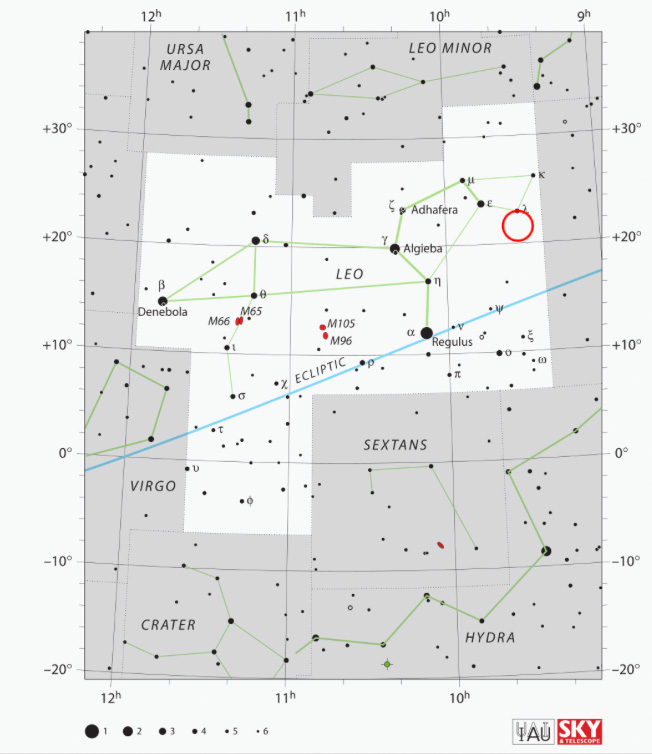
NGC 2903 is a barred spiral galaxy in the Leo constellation about 20.5 million light years from the solar system, located 1.5 degrees south of Alterf (λ Leonis). It was discovered by William Herschel and cataloged on November 16, 1784. It is a galaxy of apparent magnitude 9.7 that can be observed even with small telescopes. This is a galaxy in many ways similar to the Milky Way. Its size is only slightly smaller than ours, with a diameter of about 80,000 light years. But, unlike ours, it is younger and has a cluster of bright massive stars instead of the globular cluster. The central region of the galaxy has an exceptional rate in terms of star formation, concentrated in a ring around the nucleus, which has a diameter of just over 600 pc and includes not only a large number of bright young stars, but also a number of "emission nebulae" with brightness comparable to those of the Tarantula Nebula, with high radio frequencies, infrared rays, ultraviolet rays and X-rays. It also has at least three small satellite galaxies
|
|||