Click on the image for FULL RES |
||||
| Name / Constellation | NGC 2976 |
Other: PGC 9332, MCG 5-6-45, UGC 1913 | Uma |
|
| Coordinates | AR: 09h 47m 15.458s, +67° 54′ 58.97″ | |||
| Optics | Officina Stellare 10" f8 Richtey-Cretien | |||
| Camera-Mount | PLAYERONE POSEIDON M-PRO - ZWO ASI 1600M (ONAG)- 10Micron GM2000 QCI Mount | |||
| Filters | Antlia V-Pro LRGB | |||
| Exposure |
|
|
|
|
| Location / Date | Promiod (Valle D'Aosta-Italy) "TLP" Remote Observatory - Dic 2024 | |||
| Seeing | 2.5" @ 1.17 arcosec/pixel binning 3 | |||
| Note | Drizzle 2X in postprocessing (Pixinsight)) | |||
| Acquisition | N.I.N.A. | |||
| Processing | Adobe Photoshop CC -  |
|||
| Comment |
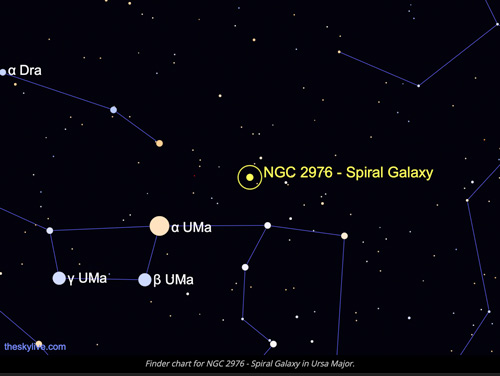
NGC 2976 is a singular dwarf galaxy in the northern circumpolar constellation of Ursa Major. It was discovered by the German astronomer William Herschel on November 8, 1801, and catalogued as H I.285. J.L.E. Dreyer described it as "bright, very large, maximum extent 152°, with one star involved". It is part of the M81 group[1] and is located 1° 20′ southwest of Messier 81. The apparent separation of this galaxy from the M81 Group is 190 kpc. The morphological classification of this galaxy is SAa, which corresponds to an unbarred spiral galaxy (SA) with very narrow spiral arms (a). The actual visual shape of the galaxy is a pure disk without spiral arms or a bulge. The brightness and size of this galaxy place it midway between the Large and Small Magellanic Clouds. De Vaucouleurs and colleagues classified it as a SAc type, suggesting loosely wound arms. The galaxy is tilted at an angle of 65° to the line of sight from Earth. Although it appears as a disk, there is evidence for a non-axis-symmetric distribution of gas, suggesting the presence of a central bar, plus large spiral arms. The internal structure contains many dark streaks, and stellar clusters. There are two H II regions of strong emission, one on each side. The total rate of new star formation is 0.2 M☉ /yr. The outer disk shows a history of stable new star formation, although the rate of formation has decreased significantly in the last billion years, and the population is now mostly made up of older stars. Within a radius of about 3 kpc from the center, new star formation remains constant, having not recently declined. There is a cloud of neutral hydrogen, with a mass of (2.67±0.65)×107 solar masses, located 27 kpc northeast of the galaxy, which could interact gravitationally with NGC 2976. The galaxy also shows signs of tidal stretching, with an extended tidal tail of neutral hydrogen. The last significant interaction occurred about a billion years ago.
|
|||