Click on the image for FULL RES |
||||
| Name / Constellation | NGC 4565 |
Other: UGC 7772, PGC 42038, Caldwell 38 | Com |
|
| Coordinates | AR: 12h 36m 20,8s - Dec: +25° 59′ 14″ | |||
| Optics | Officina Stellare 10" f8 Richtey-Cretien | |||
| Camera-Mount | SBIG ST10XME/CFW10 - ZWO ASI1600MM guider (ONAG) - 10Micron GM2000 QCI Mount | |||
| Filters | Astrodon Gen. II - LRGB | |||
| Exposure |
|
|
|
|
| Location / Date | Promiod (Valle D'Aosta-Italy) "TLP" Remote Observatory - feb 2022 | |||
| Seeing | 2.8" @ 0.7 arcosec/pixel unbinned | |||
| Note | ||||
| Acquisition | MaxIm DL - CCD Commander | |||
| Processing | Adobe Photoshop -  |
|||
| Comment |
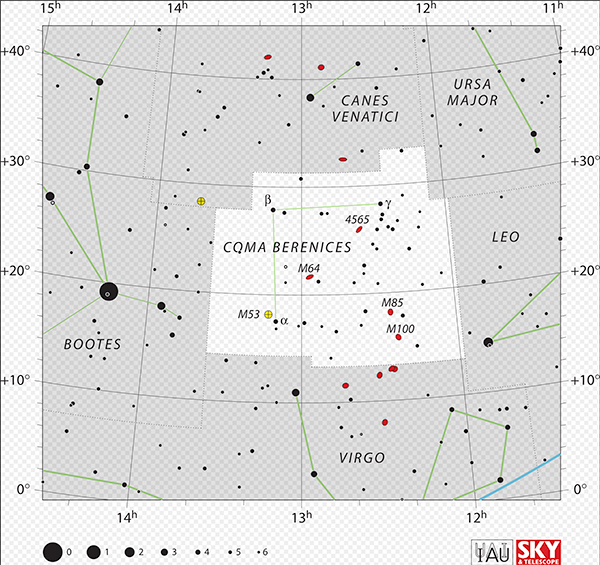
NGC 4565 (also known as the Needle Galaxy or Caldwell 38) is an edge-on spiral galaxy about 30 to 50 million light-years away in the constellation Coma Berenices. It lies close to the North Galactic Pole and has a visual magnitude of approximately 10. It is known as the Needle Galaxy for its narrow profile. First recorded in 1785 by William Herschel, it is a prominent example of an edge-on spiral galaxy. NGC 4565 is a giant spiral galaxy more luminous than the Andromeda Galaxy. Much speculation exists in literature as to the nature of the central bulge. In the absence of clear-cut dynamical data on the motions of stars in the bulge, the photometric data alone cannot adjudge among various options put forth. However, its exponential shape suggested that it is a barred spiral galaxy. NGC 4565 has at least two satellite galaxies, one of which is interacting with it. It has a population of roughly 240 globular clusters, more than the Milky Way.
|
|||