Click on the image for FULL RES |
||||
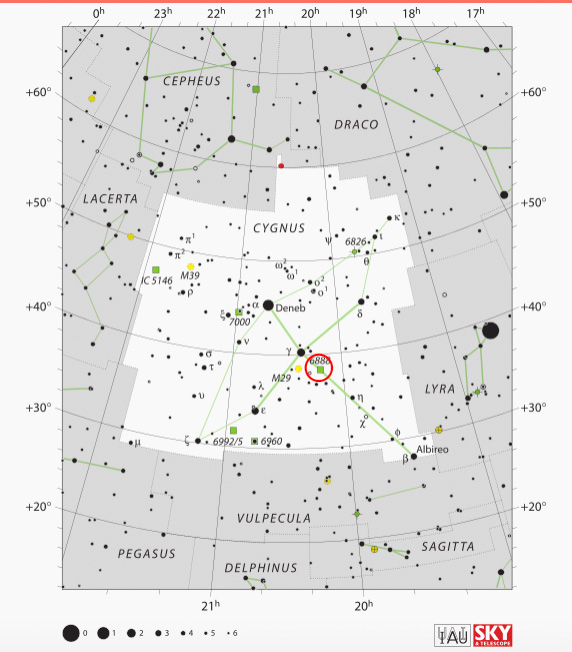
| Name / Constellation | NGC 6888 |
Other: C 27, LBN 203; Sh2-105; H IV-72; GC 4561; Crescente nebula | Cyg |
|
| Coordinates | AR: 20h 12m 06.4s - Dec: +38° 21′ 18″ | |||
| Optics | Takahashi FSQ 106N APO Fluorite F5 - 60/220 guiding refractor | |||
| Camera-Mount | ZWO ASI 294 MC Pro - Orion StarShot Guider - 10Micron GM2000 QCI Mount | |||
| Filters | Askar Magic D1 Dual Band Ha-O3 | |||
| Exposure |
|
|||
| Location / Date | Promiod (Valle D'Aosta-Italy) "TLP" Remote Observatory - 28 jun 2025 | |||
| Seeing | About 2.2" @ 1.8 arcosec/pixel unbinned | |||
| Note | SHO Palette | |||
| Acquisition | NINA | |||
| Processing | Adobe Photoshop -  |
|||
| Comment |
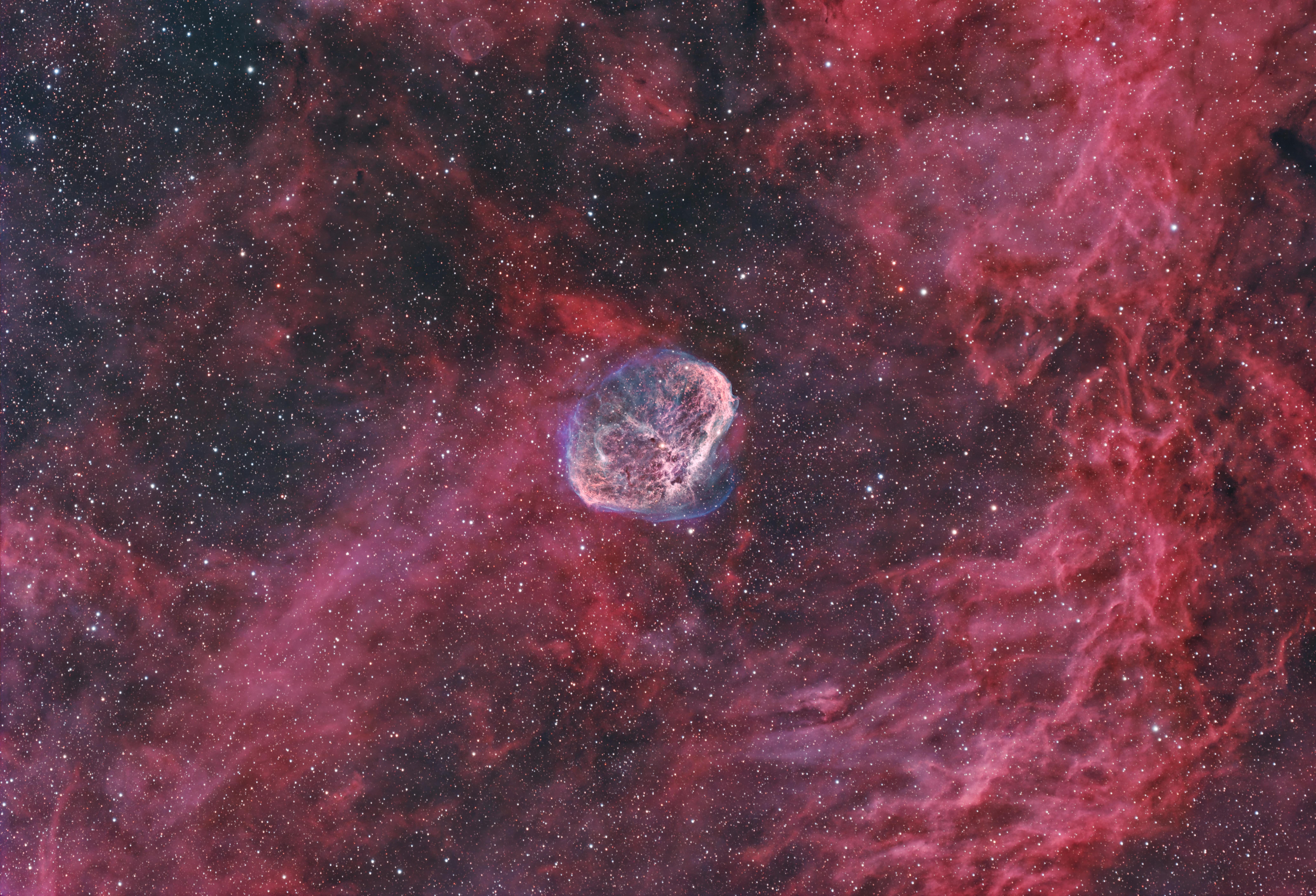
The Crescent Nebula (also known as NGC 6888, Caldwell 27, Sharpless 105) is an emission nebula in the constellation Cygnus, about 5000 light-years away from Earth. It was discovered by William Herschel in 1792. It is formed by the fast stellar wind from the Wolf-Rayet star WR 136 (HD 192163) colliding with and energizing the slower moving wind ejected by the star when it became a red giant around 250,000 to 400,000[citation needed] years ago. The result of the collision is a shell and two shock waves, one moving outward and one moving inward. The inward moving shock wave heats the stellar wind to X-ray-emitting temperatures. It is a rather faint object located about 2 degrees SW of Sadr. For most telescopes it requires a UHC or OIII filter to see. Under favorable circumstances a telescope as small as 8 cm (with filter) can see its nebulosity. Larger telescopes (20 cm or more) reveal the crescent or a Euro sign shape which makes some to call it the "Euro sign nebula".
The Soap Bubble Nebula, or PN G75.5+1.7, is a planetary nebula in the constellation Cygnus, near the Crescent Nebula (NGC 6888). It was discovered by amateur astronomer Dave Jurasevich using an Astro-Physics 160 mm refractor telescope with which he imaged the nebula on June 19, 2007 and on July 6, 2008. The nebula was later independently noted and reported to the International Astronomical Union by Keith B. Quattrocchi and Mel Helm who imaged PN G75.5+1.7 on July 17, 2008. The nebula measures 260″ in angular diameter with a central star that has a J band magnitude of 19.45.
|
|||