Click on the image for FULL RES |
||||
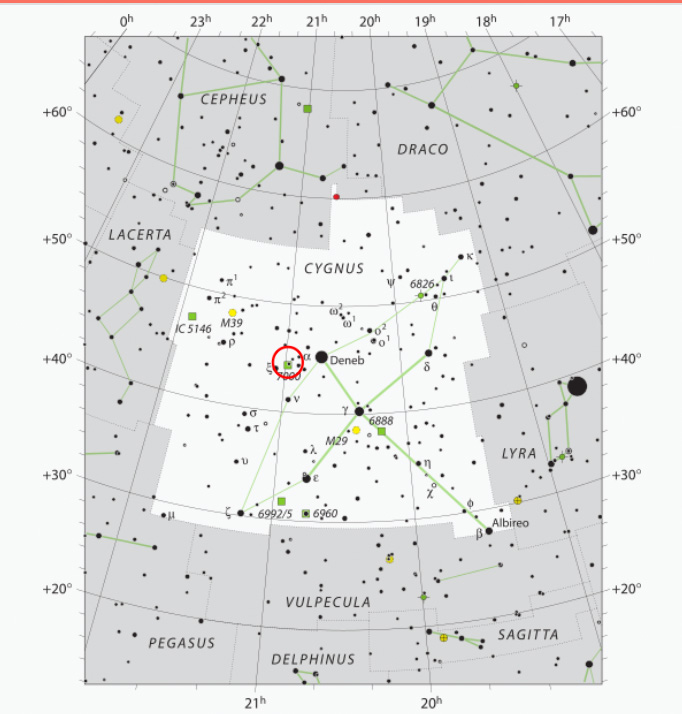
| Name / Constellation | NGC 7000 IC5070 |
Other: Sh2-220, LBN 756 | Cyg |
|
| Coordinates | AR: 20h 59m - Dec:+44° 31′ | |||
| Optics | Takahashi FSQ 106N APO Fluorite F5 - 60/220 guiding refractor | |||
| Camera-Mount | ZWO ASI 2400 MC Pro - Orion StarShot Guider - 10Micron GM2000 QCI Mount | |||
| Filters | Askar Magic D1 Dual Band Ha-O3 - Askar Magic D2 Dual Band S2-O3 - IDAS LPS D3 | |||
| Exposure |
|
|
||
| Location / Date | Promiod (Valle D'Aosta-Italy) "TLP" Remote Observatory - Sept 2025 | |||
| Seeing | About 2" @ 2.3 arcosec/pixel unbinned | |||
| Note | SHO Palette - IDAS filter for the stars | |||
| Acquisition | NINA | |||
| Processing | Adobe Photoshop -  |
|||
| Comment |
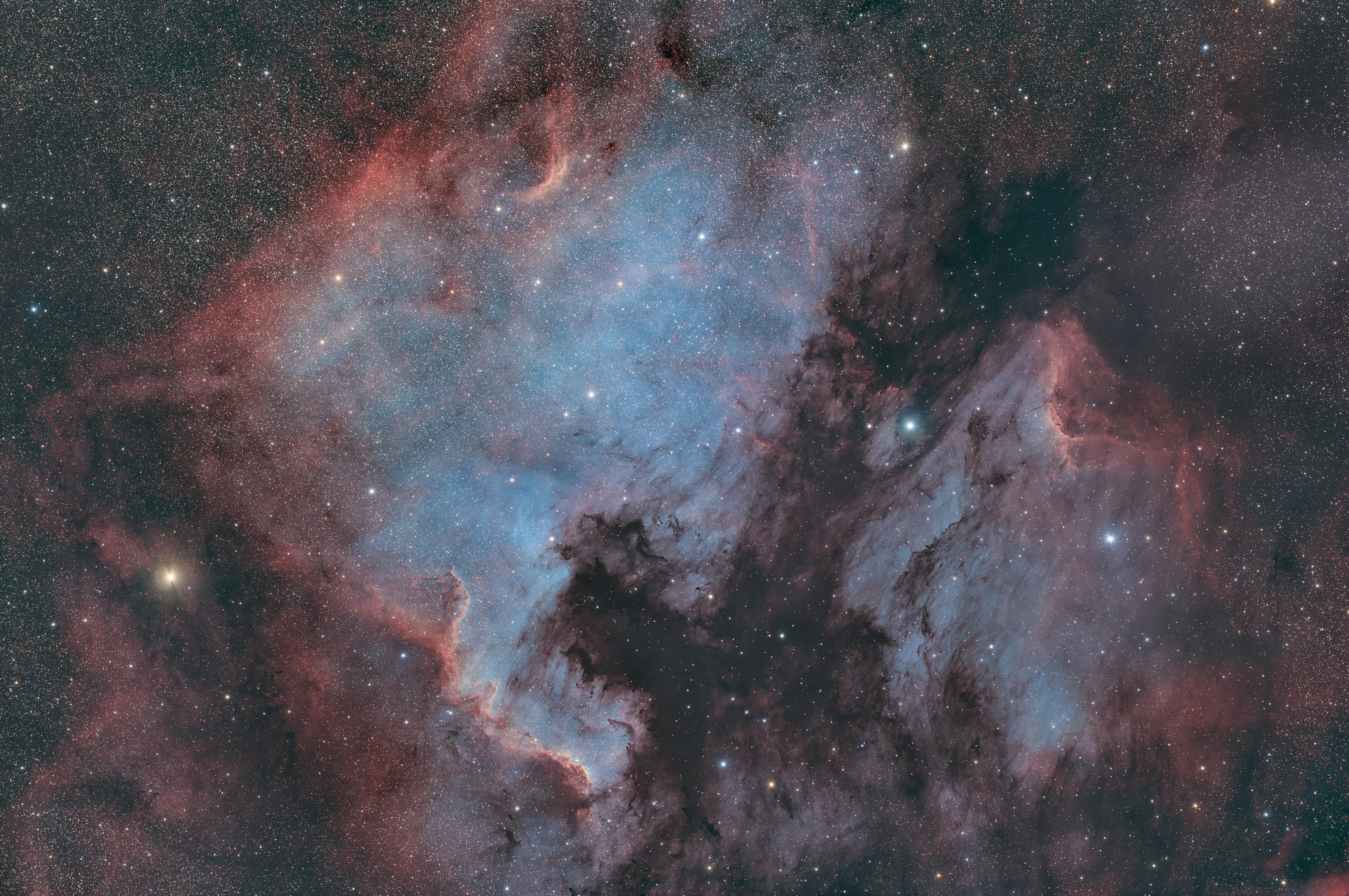
The North America Nebula and the nearby Pelican Nebula (IC 5070) are part of the same vast interstellar cloud of ionized hydrogen (Region H II); the nebulous region they together constitute is designated W80 and DR 27 and extends for approximately 3°. The two bright nebulae appear separated by a band of dark gas belonging to the same nebulous complex known as LDN 935. The region also hosts several open clusters, such as NGC 6996. This nebulous complex actually constitutes the illuminated portion of the large system of gas and dust known as the Cygnus Rift, clearly visible because it completely obscures the light of the stars beyond it and thus the brightness of the Milky Way. Between us and the nebula lies a band of interstellar dust that absorbs the light of the stars and the nebula behind it, giving it its visible shape. For a long time, the star responsible for the ionization of the cloud's hydrogen was not known with certainty; if it were Deneb, as some sources suggest, the distance would be approximately 1,800 light-years, and its absolute size would be 100 light-years (6° apparent diameter). However, this hypothesis appears rather unrealistic. Studies conducted at various wavelengths have identified around twenty sources coinciding with as many stars deeply immersed in or hidden by gas. Among these, 2MASS J205551.25+435224.6 stands out. This particularly isolated source lies beyond the dark band of LDN 935, clearly visible in the near-infrared spectrum, coinciding with a young blue star of spectral type O5V. Its location is particularly interesting because it lies exactly at the geometric center of the nebular complex, making it primarily responsible for the ionization of the surrounding gas.
|
|||