| Comment |
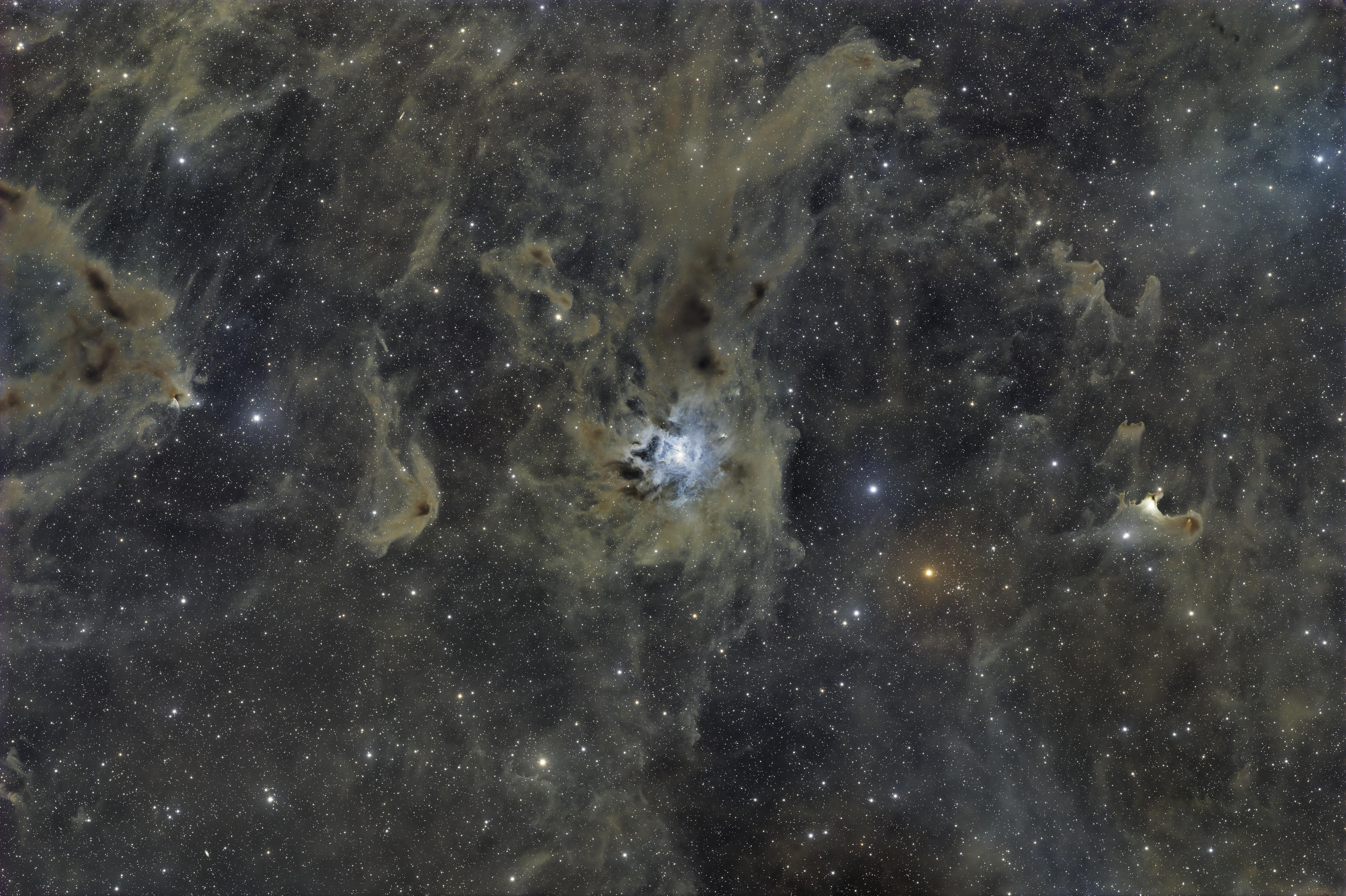
NGC 7023 (sometimes known as the Iris Nebula or by its acronym C 4) is a diffuse nebula visible in the northern constellation of Cepheus. It was discovered by William Herschel in 1794.
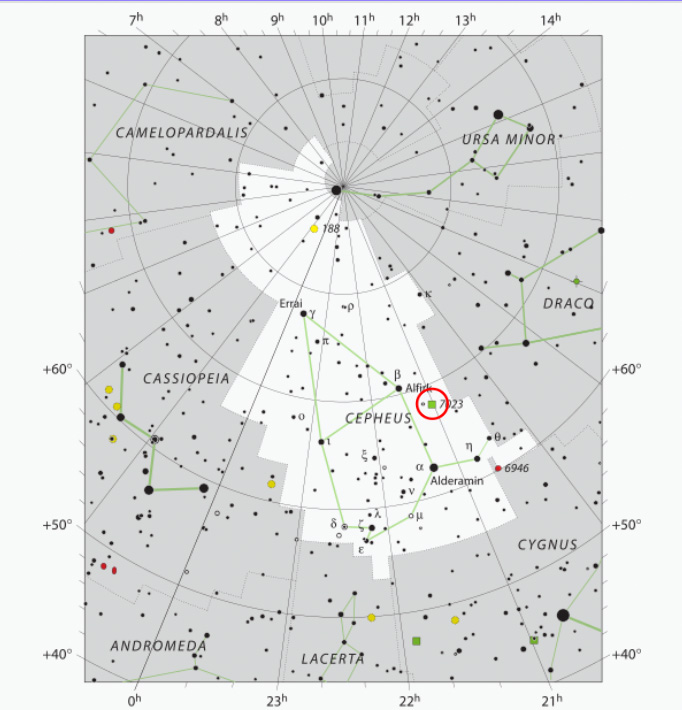
This small nebula is located about 3.5° southwest of the star β Cephei (Alfirk), a peculiar double and variable star. The nebula surrounds a magnitude 7.7 star, which is easily visible with binoculars. The nebula itself can also be seen with powerful binoculars if observing conditions are optimal. A medium-sized telescope is already capable of revealing some details of the nebula, such as a sort of central bar extending from north to south.
NGC 7023 has a strongly northern declination, therefore it appears circumpolar from much of the northern hemisphere; Although it reaches its maximum altitude in the evening sky between August and November, it remains visible year-round, reaching subtropical northern latitudes. From the Southern Hemisphere, however, its visibility is limited to the regions between the equator and the Tropic of Capricorn.
Historically, there has been some confusion about the object's nature; William Herschel, its discoverer, correctly stated that it was a nebulous object surrounding a seventh-magnitude star, as did the first edition of the New General Catalogue, which precisely listed it under the number 7023. The confusion likely began when Per Collinder, famous for compiling his catalog of open clusters, mistook it for one of these, listing it in his catalog as Cr 429. The error was later corrected, to the point that even the SIMBAD database lists it only as an open cluster. In reality, the cluster is located within the nebula.
NGC 7023 is a reflection nebula, meaning it reflects the light of several nearby stars. The star responsible for its illumination is likely the seventh-magnitude star, cataloged as HD 200775, which is shrouded in the nebula, along with other, less brilliant stars born from its dust and forming the open cluster. The nebula is likely about 1,400 light-years away and measures about 6 light-years. It is likely part of the vast Cepheus Molecular Cloud Complex.
|