Click on the image for FULL RES |
||||
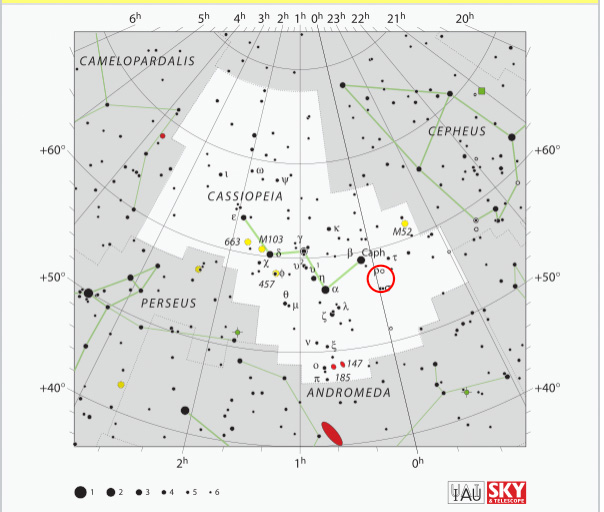
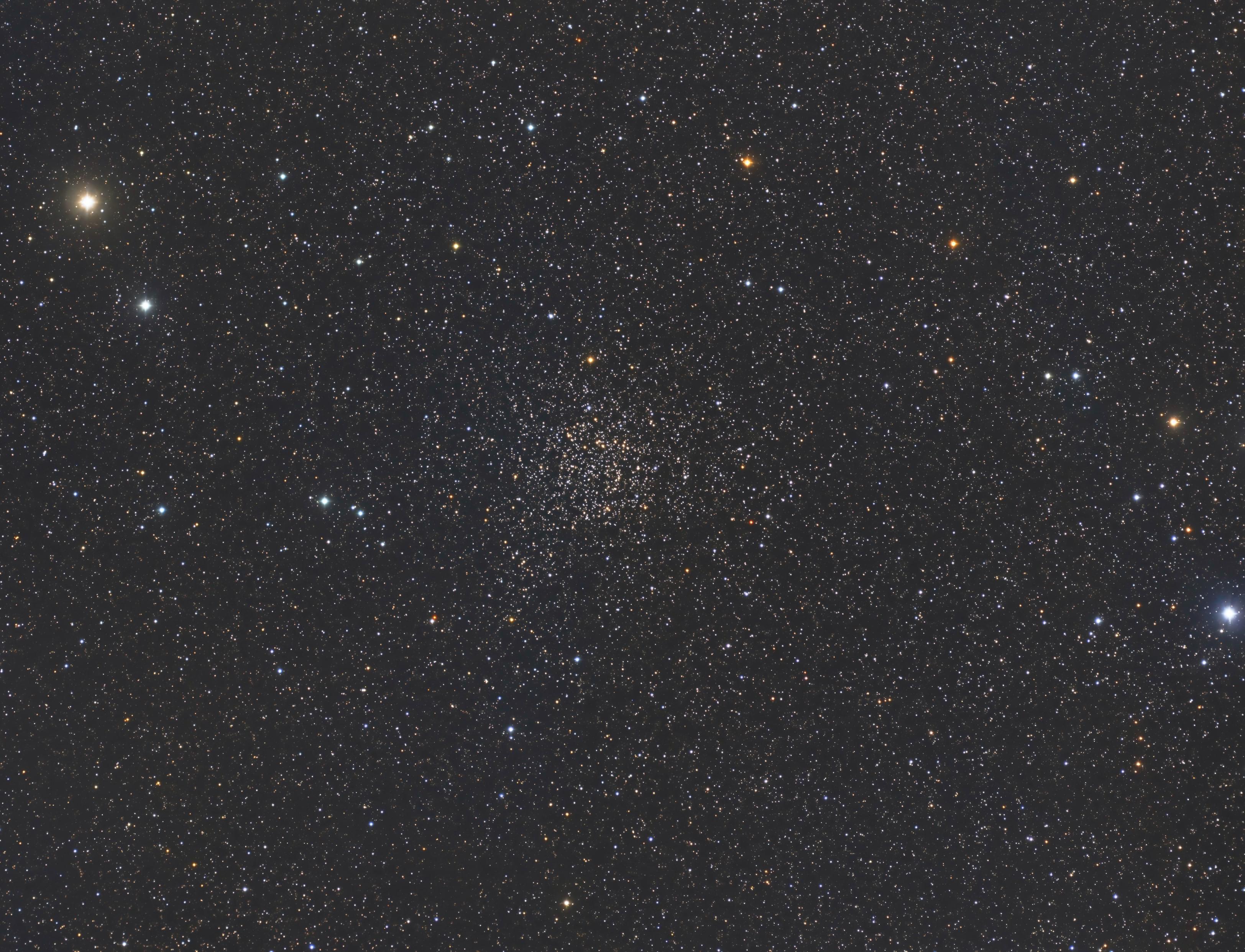
| Name / Constellation | NGC 7789 |
Other: Mel245; Cr460; OCl269 | Cas |
|
| Coordinates | AR: 23h 57m 24s - +56° 42′ 30″ | |||
| Optics | Takahashi FSQ 106N APO Fluorite F5 - 60/220 guiding refractor | |||
| Camera-Mount | SBIG STF8300M - Orion StarShot Guider - 10Micron GM2000 QCI Mount | |||
| Filters | Baader LRGB | |||
| Exposure |
|
|
|
|
| Location / Date | Promiod (Valle D'Aosta-Italy) "TLP" Remote Observatory - Genn 2021 | |||
| Seeing | About 2.8" @ 2.1 arcosec/pixel unbinned | |||
| Note | ||||
| Acquisition | MaxIm DL - CCD Autopilot 5 | |||
| Processing | Adobe Photoshop -  |
|||
| Comment |
NGC 7789 is a very rich and concentrated open cluster, formed by several hundred components; its distance is estimated at around 2337 parsecs (7620 light years), corresponding to an area inside the Perseus Arm, one of the two major spiral arms of the Milky Way. Its age is rather advanced, estimated at around 1.7 billion years or slightly less, therefore it is certainly physically unrelated to the large and very young OB associations visible in its direction and present in that section of the Perseus Arm. Many of its massive components belong to the red giant branch, others are in the phase of helium fusion in their nuclei; the stars with a lower mass are instead in the main sequence. Studies on the metallicity of these stars have allowed us to detect that the abundance of iron [Fe/H] is relatively similar to that of the Sun. In NGC 7789, almost 700 components have been identified whose magnitude is brighter than 15.5. Due to the high density of its central regions, several stars have undergone such an interaction that they have merged with each other, becoming blue stragglers. Clusters of this type are useful for understanding various mechanisms of stellar evolution. In studies focused on the search for extrasolar planets through the transit method, 14 stars have been identified showing variation effects similar to planetary transits; in addition to these there would be some simple long-period cataclysmic variables.
|
|||