Click on the image for FULL RES

Name / Constellation

Sh2 101

Other: Ced 173; LBN 168; Avedisova 935; Tulip Nebula

Cyg

Coordinates AR: 19h 59m 55s, +35° 16′ 36″
Optics Takahashi FSQ 106N APO Fluorite F5 - 60/220 guiding refractor
Camera-Mount SBIG STF8300M - Orion StarShot Guider - 10Micron GM2000 QCI Mount
Filters Baader Halpha 7 nm - Oxygen 3 -Sulfur 2
Exposure
  • Halpha
  • Oxygen 3
  • Sulfur 2
  • 20 x 900 sec - 5 hours
  • 19 x 900 sec - 4 hours 45min
  • 13 x 900 sec - 3 hours 15min
  • UNBINNED
  • UNBINNED
  • UNBINNED
Location / Date Promiod (Valle D'Aosta-Italy) "TLP" Remote Observatory - Sept 2023
Seeing About 3 @ 2.1 arcosec/pixel unbinned
Note SHO palette
Acquisition N.I.N.A.
Processing Adobe Photoshop -
Comment

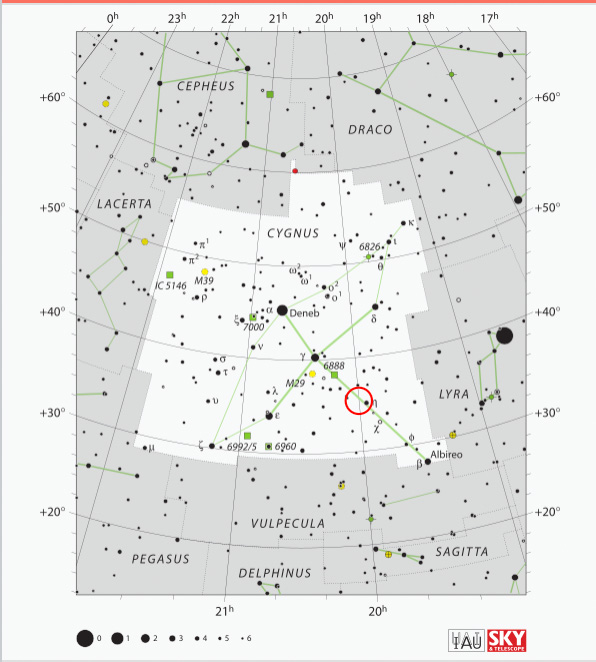
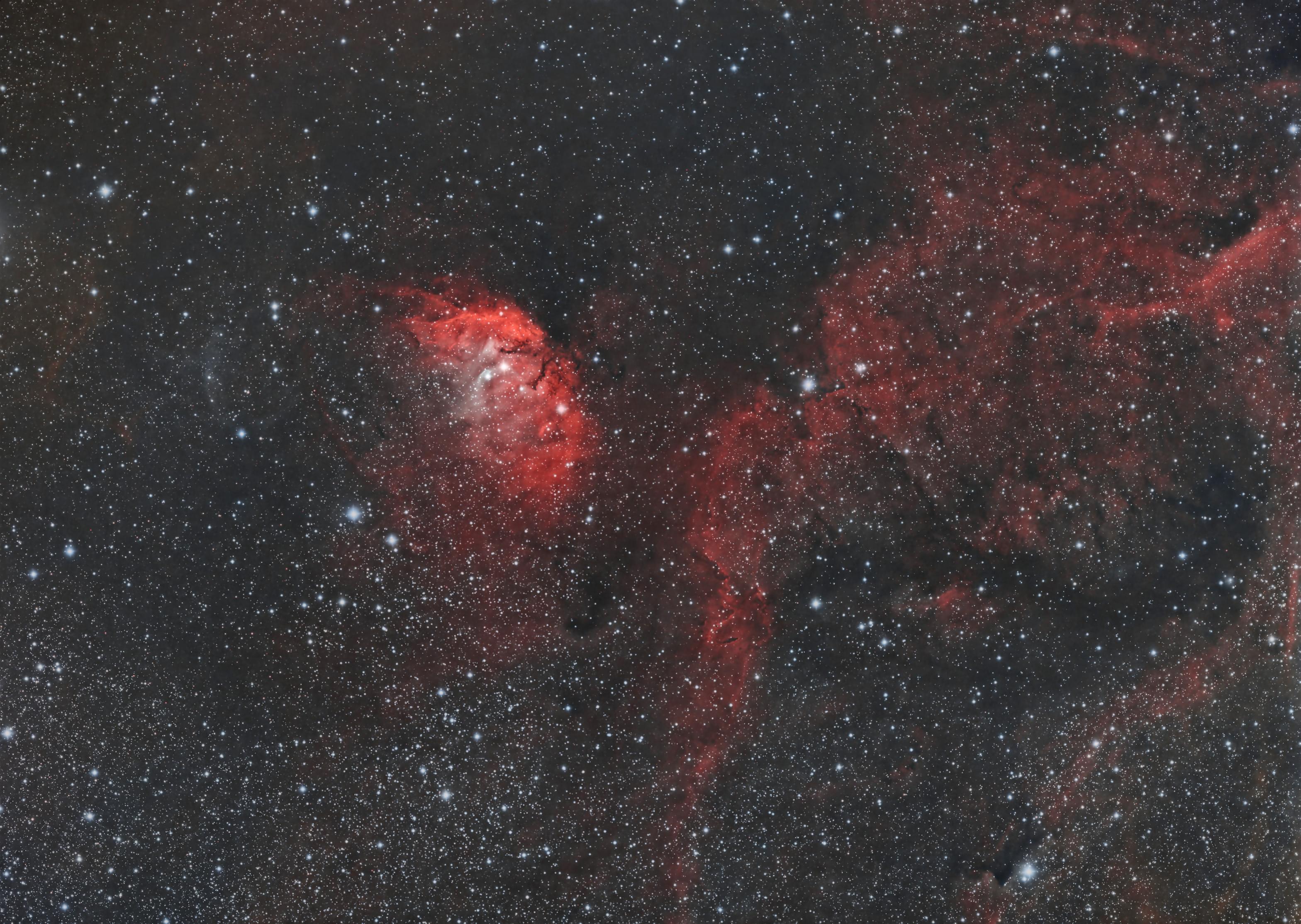
The Tulip Nebula (also known as Sh2-101) is an emission nebula visible in the constellation of Cygnus.
It is located in the central-southern part of the constellation, at the center of a very bright stretch of the Milky Way and rich in star fields; it is located about 45' northeast of the star η Cygni and extends for about twenty minutes in a NE-SW direction. It has an elongated and irregular shape; the best period for its observation in the evening sky falls between the months of June and November.
It is a large H II region located on the initial stretch of the Orion Arm about 2700 parsecs (8750 light years) away from the solar system, beyond the large nebulous complex of Cygnus X, from which it would be no more than 500 parsecs away. This distance coincides with that estimated for the OB association Cygnus OB3, which contains about thirty massive stars of the first spectral classes with an age of about 8.3 million years. The source of the ionizing radiation in the gases of the nebula is believed to be the star HD 227018, a blue giant of class O6.5III and an apparent magnitude of 9.01. According to the Avedisova catalog, the nebula would host some active star formation phenomena, as would be demonstrated by the presence of four sources of infrared radiation reported in the IRAS catalog: IRAS 19581+3504, IRAS 19579+3509, IRAS 19584+3506 and IRAS 19584+3515, in addition to some sources of radio waves.