Click on the image for FULL RES |
||||
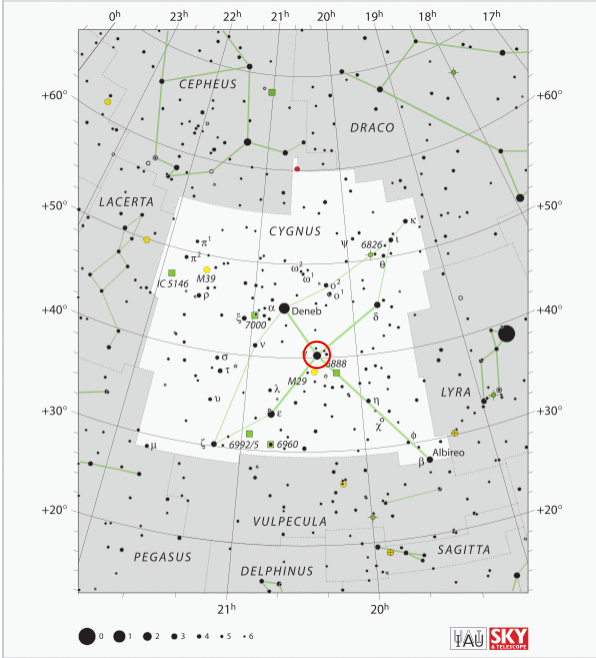
| Name / Constellation | Sh2 108 |
Other:Gamma Cygni Neb, LBN 234, IC 1318 | Cyg |
|
| Coordinates | AR: 20h 22m - Dec: +40° 15′ | |||
| Optics | Takahashi FSQ 106N APO Fluorite F5 - 60/220 guiding refractor | |||
| Camera-Mount | SBIG STF8300M - Orion StarShot Guider - 10Micron GM2000 QCI Mount | |||
| Filters | Baader Ha-Oxy3_Sul2 | |||
| Exposure |
|
|
|
|
| Location / Date | Promiod (Valle D'Aosta-Italy) "TLP" Remote Observatory - Jun 2023 | |||
| Seeing | 2.5-3" @ 2.1 arcosec/pixel unbinned | |||
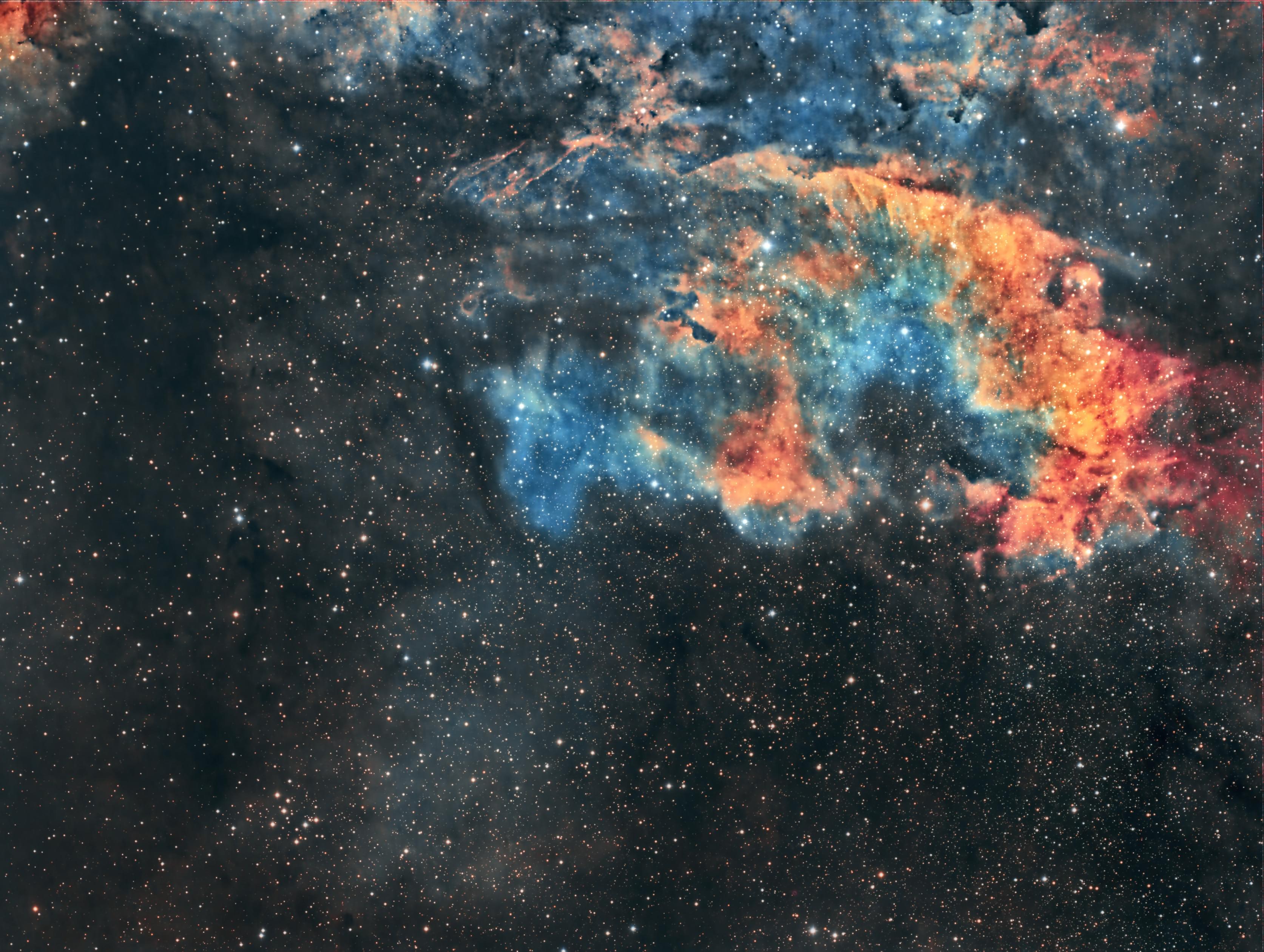
| Note | SHO palette - Only part of Gamma Cygni Nrbula | |||
| Acquisition | N.I.N.A. | |||
| Processing | Adobe Photoshop -  |
|||
| Comment |
SH2-108 (IC 1318) is a large complex of diffuse nebulae observable in the constellation of Cygnus; it is part of the large molecular nebula complex of Cygnus, one of the largest and most massive nebulous areas of our Galaxy. IC 1318 is located in the area of sky where the star γ Cygni, Sadr, the "heart" of Cygnus is located; it extends for a few degrees to the northeast and southwest of this star, veiling a particularly intense region of the Milky Way. It can be observed, from the northern hemisphere, for most of the year, and from the medium latitudes it appears at the zenith. From the southern hemisphere, however, this stretch of sky is observable with great difficulty, especially starting from the medium southern latitudes in a southerly direction; in the southern tropical belt, however, it is fairly observable. The complex is made up of several nebulous areas, often crossed by dark nebulae, more or less surrounding the star Sadr and more or less detached from each other, to the point that they have been classified as separate nebulae: they are in fact numbered from IC 1318a to IC 1318e, going from west to east. What makes the nebula bright is not, as it may seem, the star Sadr, since in reality it is not linked to the molecular complex: even if it is a very distant star, located around 1500 light years from us, it is definitely in the foreground with respect to the nebulous field. Star formation, a phenomenon that is otherwise widespread in this region of the Galaxy, would be slowing down only in some small areas on the outskirts of this substructure.
|
|||