Click on the image for FULL RES |
||||
| Name / Constellation | Sh2 - 129 / OU4 |
Flying Bat Nebula, Squid nebula | Cep |
|
| Coordinates | AR: 21h 11m - Dec: +59° 57′ | |||
| Optics | Takahashi FSQ 106N APO Fluorite F5 - 60/220 guiding refractor | |||
| Camera-Mount | ZWO ASI 2400 MC PRO - Orion StarShot Guider - 10Micron GM2000 QCI Mount | |||
| Filters | Askar Magic D1 Dual Band Ha-O3 | |||
| Exposure | 44 x 300sec - 3h 40m |
|
||
| Location / Date | Promiod (Valle D'Aosta-Italy) "TLP" Remote Observatory - 31 Ago 2025 | |||
| Seeing | About 2.2" @ 2.3 arcosec/pixel unbinned | |||
| Note | SHO palette | |||
| Acquisition | NINA | |||
| Processing | Adobe Photoshop -  |
|||
| Comment |
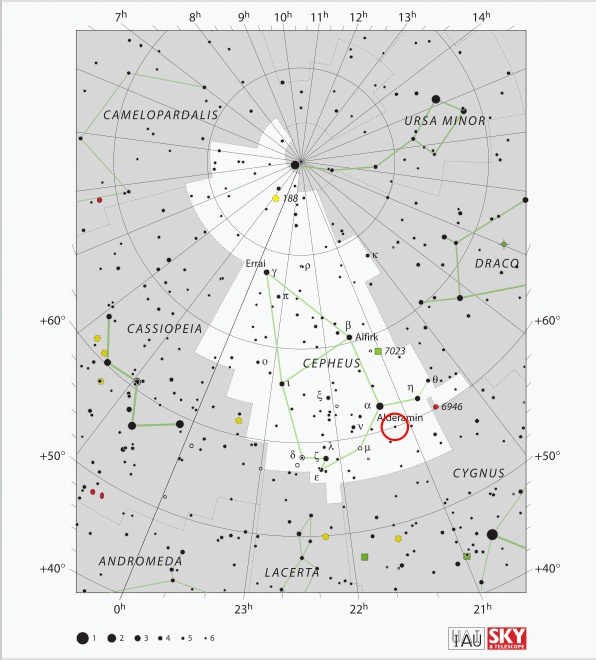
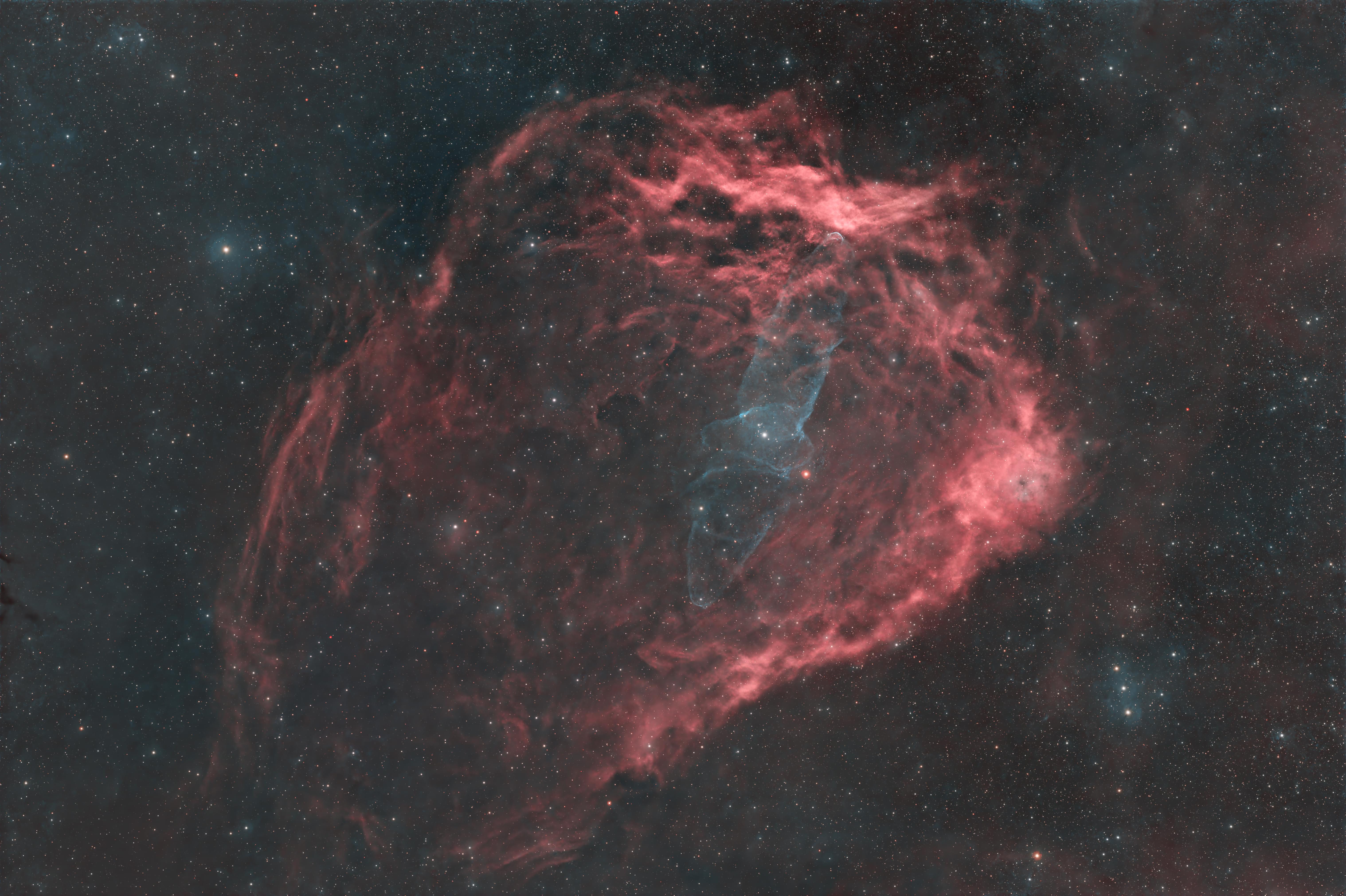
Sh2-129 is an extensive emission nebula visible in the constellation Cepheus. It is located on the southern edge of the constellation, northwest of the large nebulous complex IC 1396, although it is physically located at a great distance from it. The best time to observe it in the evening sky is between July and December, and it is significantly easier for observers located in the Northern Hemisphere. This nebula has a very pronounced arc-like shape, almost a large ring; due to its shape, it is sometimes nicknamed the Flying Bat Nebula. Despite its size, it appears rather faint, with the densest and most visible part coinciding with its eastern edge. Its distance has been estimated at around 400 parsecs (1300 light-years), placing it a short distance from the edge of the Gould Belt. The surroundings of this nebula are particularly rich in molecular clouds, first and foremost the large dark nebula system responsible for occulting much of the Milky Way in the direction of Cepheus; numerous other minor molecular clouds, most of which were recorded in a 1994 study, extend particularly towards the west, most of which have a mass that only rarely exceeds 30-40 M⊙. The exception is the cloud [DBY94] 97, which has a mass of 2440 M⊙. The infrared radiation source IRAS 21168+5948 is indicated as coinciding with the CO emission region of the same coordinates in the Avedisova Catalogue of Star-Forming Regions. The Squid nebula (OU4) occupies over one degree of the night sky, representing the largest angular extent ever found in a planetary nebula. Known colloquially as the giant squid nebula, it is physically nearly 50 light years across. This bipolar nebula could be one of the nearest of its type known, situated around 2300 light years away, though it being a planetary nebula needs confirmation. Even though it is big and close, you're not likely to find it easily. It is an extremely faint nebula emitting primarily O3 signal and resides within the larger Flying Bat nebula (sh2-129) which tends to overshadow it, making it a challenging target to image. The Squid shape is created by the outflow of material driven by a triple system of hot, massive stars catalogued as HR8119 (blue hypergiant) as well as the pulsating variable star v419 Cephei (red supergiant) seen near the center. While their shapes do their names justice, to me, the Squid seated within the Flying Bat more resembles a hand holding an infinity stone (viewed sideways) rather than a Bat carrying a bejeweled Squid on its back.
|
|||