Click on the image for FULL RES |
||||
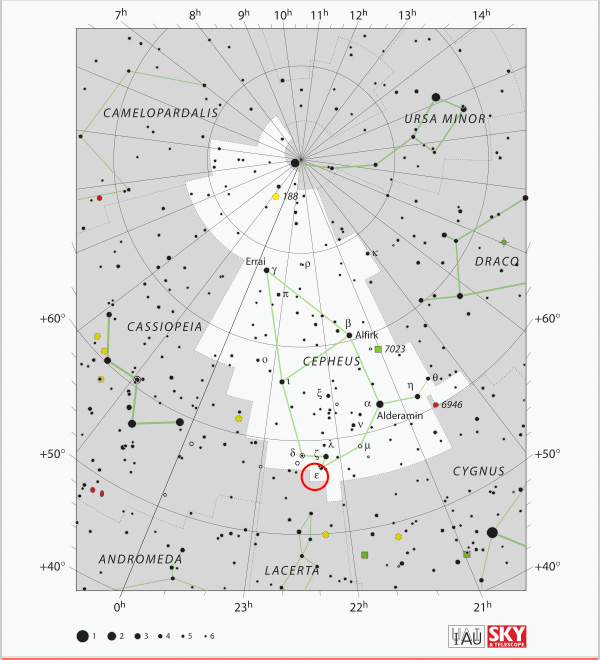
| Name / Constellation | Sh2 132 |
Other: Lion Nebula; LBN 473 | Cep |
|
| Coordinates | AR: 22h 19m 09s - Dec: +56° 04′ 45″ | |||
| Optics | Takahashi FSQ 106N APO Fluorite F5 - 60/220 guiding refractor | |||
| Camera-Mount | SBIG STF8300M - Orion StarShot Guider - 10Micron GM2000 QCI Mount | |||
| Filters | Baader Ha-Oxy3_Sul2 | |||
| Exposure |
|
|
|
|
| Location / Date | Promiod (Valle D'Aosta-Italy) "TLP" Remote Observatory - Jul 2023 | |||
| Seeing | 2.5-3" @ 2.1 arcosec/pixel unbinned | |||
| Note | SHO palette | |||
| Acquisition | N.I.N.A. | |||
| Processing | Adobe Photoshop -  |
|||
| Comment |
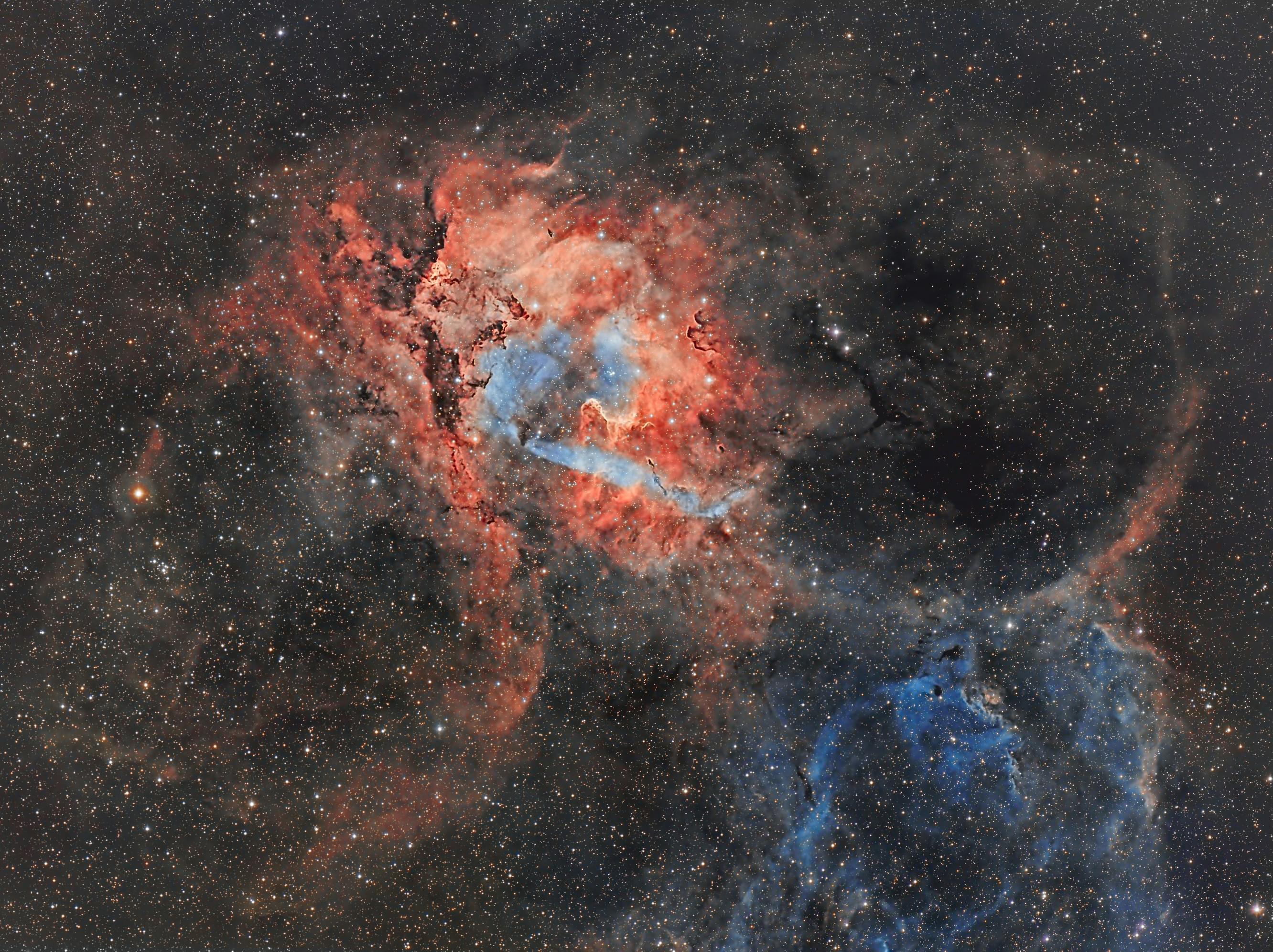
Sh2-132 is an extended emission nebula visible in the constellation of Cepheus. Sh2-132 is located at a distance of almost 3200 parsecs (almost 10400 light years), thus placing it within the Perseus Arm, in the region of Cepheus OB1, a large and bright OB association. The stars responsible for the ionization of its gases are very hot and massive; in particular, two Wolf-Rayet stars have been identified, known by the acronyms HD 211564 and HD 211853 (the latter also having the acronym WR 153), as well as a star of spectral class O8.5V and about ten stars of class B. Around the star of class O and one of the Wolf-Rayet stars there is a bubble clearly visible in the radio wave band, identified by the acronym Shell B, probably originating from the stellar wind of the two massive stars. A similar but smaller structure, Shell A, hosts a star of class K near its center. It is believed that chain star formation processes have taken place in the past in the nebula; currently these processes seem to be suspended, since there is no trace of recent activity. Nine sources of infrared radiation and a maser with H2O emissions have been identified in the direction of the nebula.
|
|||