Click on the image for FULL RES |
||||
| Name / Constellation | Sh2 223 |
Other:HB9; LBN 768 | Aur |
|
| Coordinates | AR: 05h 17m 12s - Dec: 42° 12′ | |||
| Optics | Takahashi FSQ 106N APO Fluorite F5 - 60/220 guiding refractor | |||
| Camera-Mount | SBIG STF8300M - Orion StarShot Guider - 10Micron GM2000 QCI Mount | |||
| Filters | Baader Ha-Oxy3_Sul2 | |||
| Exposure |
|
|
|
|
| Location / Date | Promiod (Valle D'Aosta-Italy) "TLP" Remote Observatory - Gen 2021 | |||
| Seeing | 2.5-3" @ 2.1 arcosec/pixel unbinned | |||
| Note | SHO palette | |||
| Acquisition | MaxIm DL - CCD Autopilot5 | |||
| Processing | Adobe Photoshop -  |
|||
| Comment |
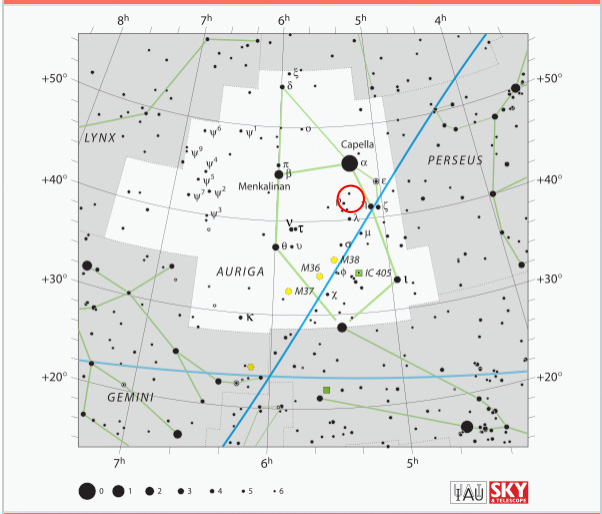
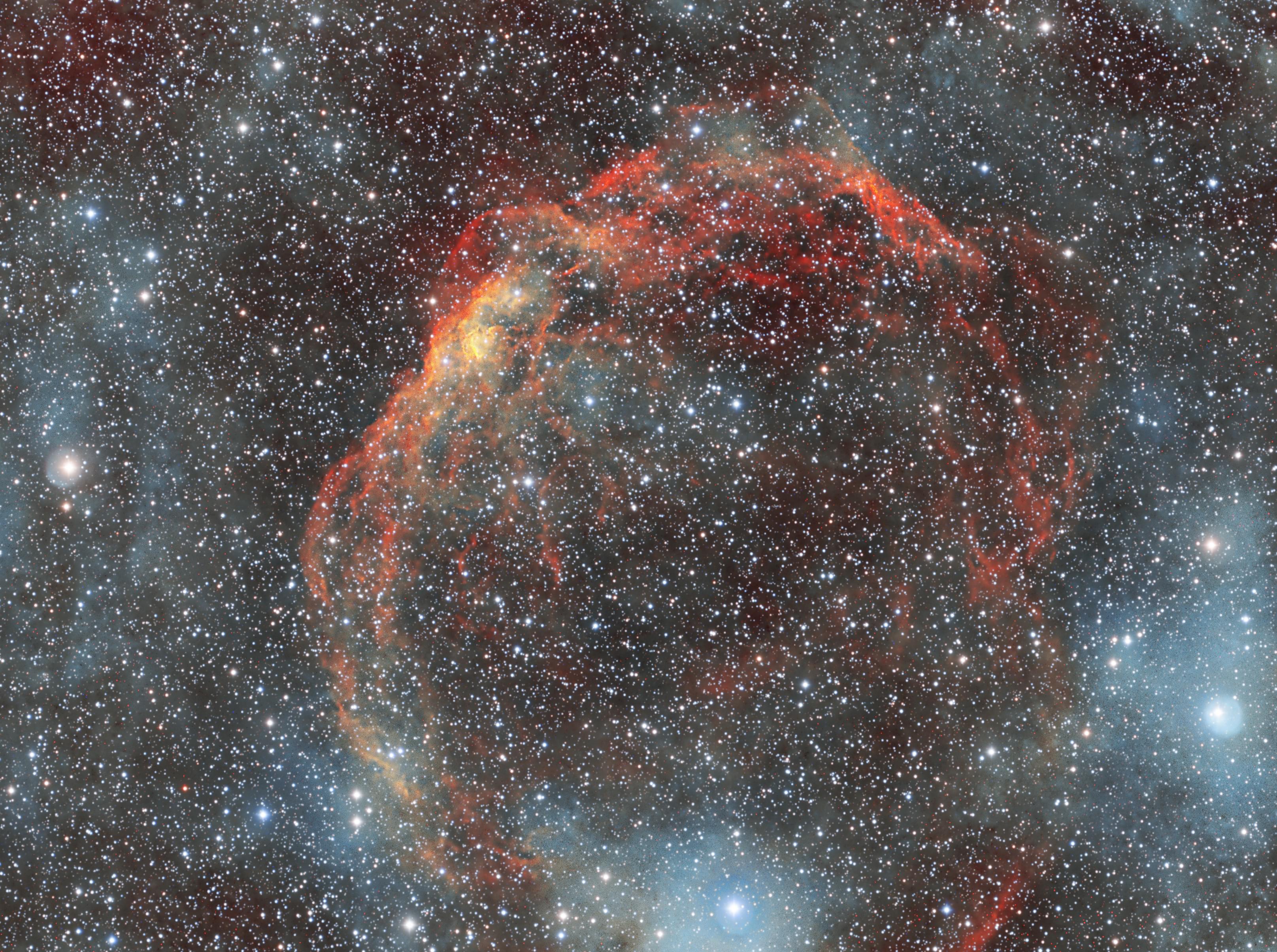
Sh2-223 is an emission nebula visible in the constellation of Auriga. It is located approximately one degree east of η Aurigae; it has the appearance of a faint nebulous arc oriented in a northeast-southwest direction, whose largest concentration is found at the center of the arc itself. The declination of the cloud is moderately northern, therefore it can be easily observed especially from the regions of the Northern Hemisphere, where it appears circumpolar up to the medium temperate latitudes; from the Southern Hemisphere visibility is partly penalized. The object was considered to be an extremely evolved (and therefore very dispersed) supernova remnant, located at a distance of 8000 parsecs (26100 light years), i.e. on the outermost edge of the Milky Way, in the direction of the External Arm; it received the acronym OA 184, as a supernova remnant, and its emissions in radio waves were studied in depth. A 2006 study, however, strongly doubts the belonging of this cloud to the class of supernova remnants, opting for a classification as an H II region; this solution was chosen due to the identification of an ionizing star of its gases, a blue star of spectral class O7.5V catalogued as BD+41 1144, distant however only 2200 parsecs (7170 light years), with a margin of error of about 400 parsecs. The distance is compatible with the galactic region of the Perseus Arm.
|
|||