Click on the image for FULL RES |
||||
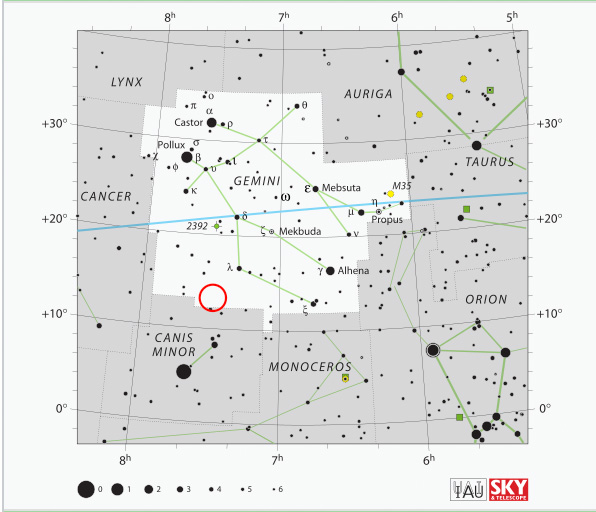
| Name / Constellation | Sh2 274 |
Other: Abell 21; PK 205+14 1 | Gem |
|
| Coordinates | AR: 07h 29m 03s - Dec: +13° 14′ 48″ | |||
| Optics | Celestron Edge 8 HD / F7 Reducer - Celestron OAG + ZWO ASI 174 MM Mini | |||
| Camera-Mount | ZWO ASI 294 MC - iOptron CEM40 Mount | |||
| Filters | 2" Optolong L-Extreme | |||
|
|
|||
| Location / Date | Novara City (Piedmont - Italy) - Feb 2023 | |||
| Seeing | 3.4 arcsec | |||
| Note | Near the cemtre of town - Bortle 7-8 | |||
| Acquisition | N.I.N.A. | |||
| Processing | Adobe Photoshop -  |
|||
| Comment | Abell 21 (also known as the Medusa Nebula or Sh2-274) is a planetary nebula visible in the constellation of Gemini. It is observed in the southern part of the constellation, on the border with Canis Minor; it can be identified with the help of 6 Canis Minoris, a fourth magnitude star from which the nebula is just 1°20' in a NNW direction. Thanks to its size and relatively high brightness, it is an easy subject for amateur astrophotography, if you have a medium-high power telescope. The most favorable period for its observation in the evening sky is from December to May and observers in the Northern Hemisphere are slightly more advantaged, although the low declination of the cloud makes it visible from all populated areas of the Earth. The nebula appears as a tangle of bright filaments oriented to form a sort of semi-conference open on the northwestern side; Its appearance makes it very similar to a supernova remnant, to the point that it was initially considered as such. Later, through measurements of its emissions and its expansion speed, it was discovered that it belongs to the class of planetary nebulae, although in an advanced stage due to its age, estimated at around 8800 years. The central star, a white dwarf, is located in a particular position on the HR Diagram, below the white dwarf branch, almost on the edge of the band where the white main sequence stars are found.
|
|||