Click on the image for FULL RES |
||||
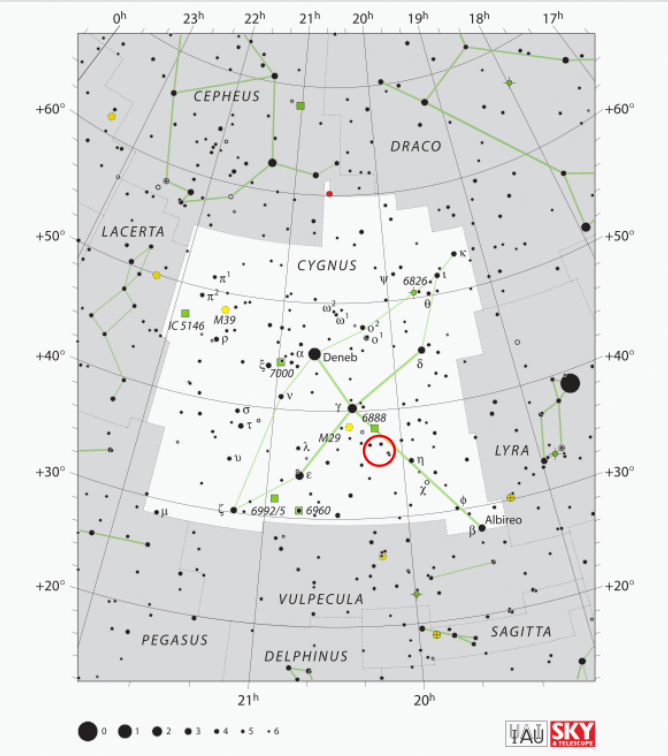
| Name / Constellation | WR 134 |
Other: HD 191765, HIP 99377, SAO 69541 | Cyg |
|
| Coordinates | AR: 20h 10m 14,19s - Dec: 36° 10′ 35,06″ | |||
| Optics | Takahashi FSQ 106N APO Fluorite F5 - 60/220 guiding refractor | |||
| Camera-Mount | ZWO ASI 2400 MC Pro - Orion StarShot Guider - 10Micron GM2000 QCI Mount | |||
| Filters | Askar Magic D1 Dual Band Ha-O3 | |||
| Exposure |
|
|||
| Location / Date | Promiod (Valle D'Aosta-Italy) "TLP" Remote Observatory - Sept 2025 | |||
| Seeing | About 2" @ 2.3 arcosec/pixel unbinned | |||
| Note | HOO Palette | |||
| Acquisition | NINA | |||
| Processing | Adobe Photoshop -  |
|||
| Comment |
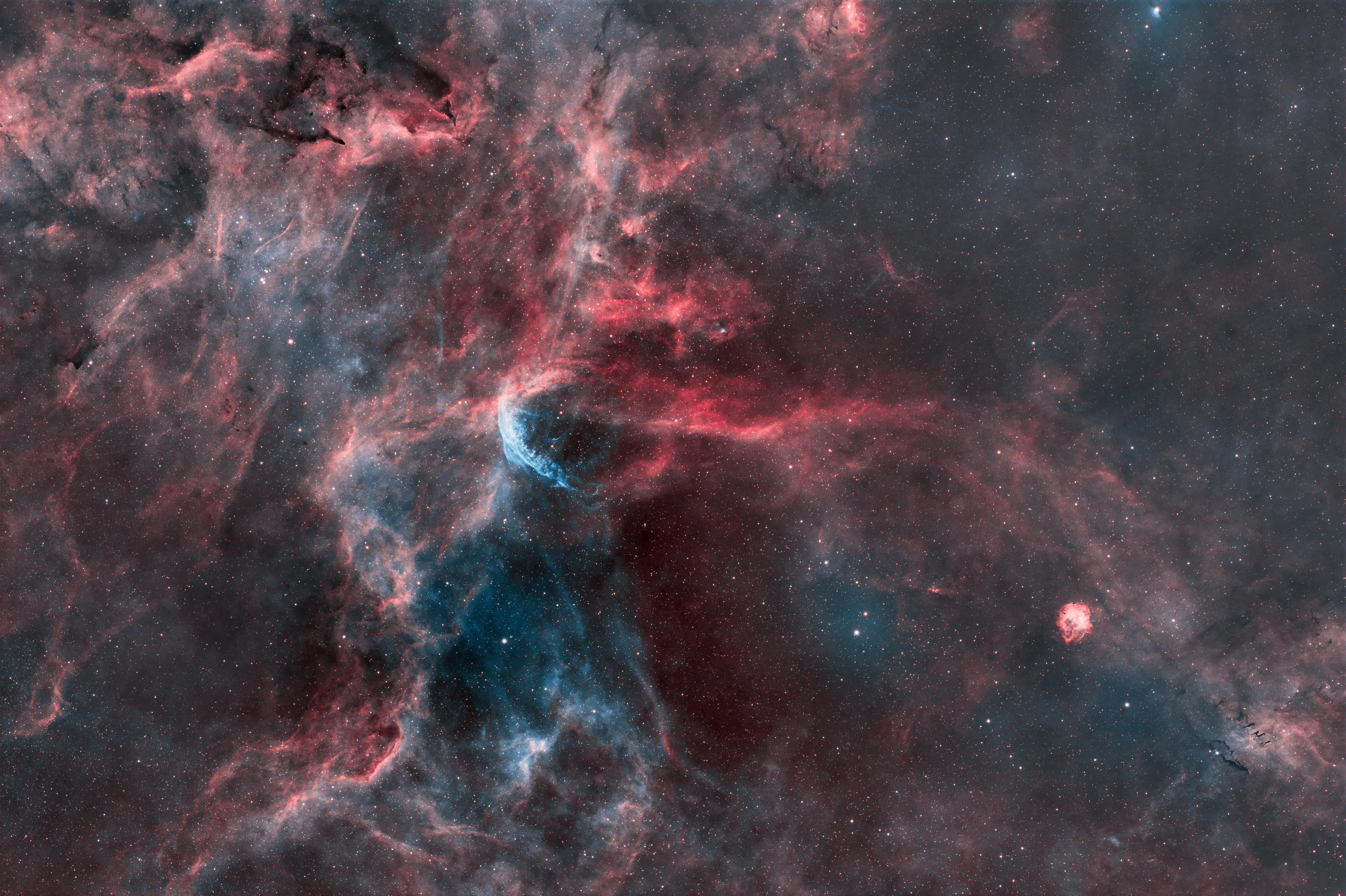
WR 134 is a variable Wolf-Rayet star in the constellation Cygnus, approximately 5,700 ly from the Sun. With a magnitude of 8.08, it is not visible to the naked eye, but binoculars are sufficient for observation. The star is surrounded by a faint nebula produced by the intense stellar wind emitted by the star. It is intrinsically very luminous (400,000 times brighter than the Sun). This brightness is due not so much to its radiant surface, as the star has a radius of 5.29 R☉, but to its very high surface temperature of 63,100 K, typical of Wolf-Rayet stars. Like stars of its class, WR 134 loses mass at a very rapid rate (4 × 10⁻⁵ M☉ per year[2]) through very fast stellar winds (1820 km/s[2]). Born as a star of spectral class O, the star has lost a significant fraction of its initial mass, which is now reduced to 19 M☉. The cause of this star's variability has not yet been precisely established. It has been classified as an Algol-type eclipsing variable and has been given the designation V1769 Cygni; however, the variations are irregular, with periods ranging from hours to days. Morel et al. (1999) identify a period of 2.25 ± 0.05 days in the variations of the spectral lines, although this has no clear equivalent in photometric observations. The researchers argue that, rather than the presence of a compact companion (a neutron star or a black hole), the variations must be attributed to the star's inhomogeneous emission of stellar wind and, therefore, to its rotation. Rustamov & Cherepashchuk (2012) suggest a period of 1.887 days in the spectroscopic variations and irregular variations of 0.1 magnitude with periods of minutes or days in the star's brightness. They hypothesize that the spectroscopic variations are due to the presence of a low-mass companion, of spectral class M or K. WR 134 emits both soft and hard X-rays, but their origin has not yet been plausible. The X-ray radiation appears to be too massive to originate from a single star. In particular, the shocks occurring in the intense and fast stellar wind should not be sufficient to produce the observed radiation. On the other hand, if a massive companion such as a black hole or a neutron star were present, the acceleration it would cause in the stellar wind should produce larger quantities of X-rays than those observed.
|
|||